


[2026] Pass Microsoft AB-210 Exam in First Attempt Easily
The Most Efficient AB-210 Pdf Dumps For Assured Success
NEW QUESTION # 16
You need to configure the new lead qualification experience in Dynamics 365 Sales for field sellers.
What should you configure?
- A. Set related record creation to Seller.
- B. Set related record creation to Automatic.
- C. Enable auto-create records for newly qualified leads.
- D. Allow Copilot to summarize key info.
- E. Use the Lead to Opportunity Business Process Flow.
Answer: A
Explanation:
The correct configuration is to set related record creation to Seller. The case study states that sales leadership requires flexibility in how leads are converted: inside sales need automatic opportunity creation, but field sellers need the option to manually decide whether an opportunity should be created when a lead is qualified.
In the new lead qualification experience, Dynamics 365 Sales lets administrators control whether account, contact, and opportunity records are created automatically during lead qualification or whether sellers are prompted to choose which related records to create. Microsoft's lead qualification guidance confirms that when automatic creation is not enabled, sellers are prompted to select which records should be created during qualification.
Option B and option E are wrong for field sellers because automatic creation would remove the manual decision point required by the case study. Option C is relevant to guiding sellers through sales stages, but the existing Lead to Opportunity Business Process Flow does not control whether related records are automatically created when a lead is qualified. Option D is unrelated because Copilot summaries help sellers review record information; they do not configure lead conversion behavior. Therefore, the required configuration for field sellers is Seller-controlled related record creation.
References/topics: Lead qualification experience; lead-to-opportunity conversion; related account, contact, and opportunity creation; Dynamics 365 Sales lead management.
NEW QUESTION # 17
You are the Dynamics 365 Sales administrator for an electronics company.
The sales team is having difficulty locating different products in the same category - for instance, all versions of flat screen TVs available.
You need to organize the products in a way that makes it easier for the sales team to search for products.
What should you use?
- A. Product families
- B. Related products
- C. Product unit groups
- D. Product bundles
Answer: A
Explanation:
The correct answer is Product families because the requirement is to organize similar products into searchable categories. In Dynamics 365 Sales, product families are used to classify and group related products under a product hierarchy. Microsoft's product catalog guidance explains that products can be created as standalone products or inside a family depending on how the organization wants to organize and classify them, and the training module specifically describes creating product family hierarchies that include product bundles and individual products.
For the example in the question, "flat screen TV" would be the product family, while individual versions such as 42-inch, 55-inch, OLED, QLED, or 4K models would be products inside that family. This makes browsing and searching easier for sellers because related variants are grouped logically. Product unit groups define how products are sold, such as each, box, or case; they do not categorize products. Related products are used for cross-sell, upsell, substitute, or accessory recommendations, not primary catalog organization. Product bundles combine multiple products sold together as a package. Therefore, the correct catalog structure is Product families .
References/topics: Product catalog setup; product families; product classification; product hierarchy; Dynamics 365 Sales core product configuration.
NEW QUESTION # 18
A sales manager needs to set up goals in Dynamics 365 Sales for salespeople.
The measurement of goals must be based on the total deal amount upon closing an opportunity.
The fiscal year for the goals must be based on the calendar year.
You need to create the rollup query for the goal metrics.
Which options should you select? To answer, select the appropriate options in the answer area.
NOTE: Each correct selection is worth one point.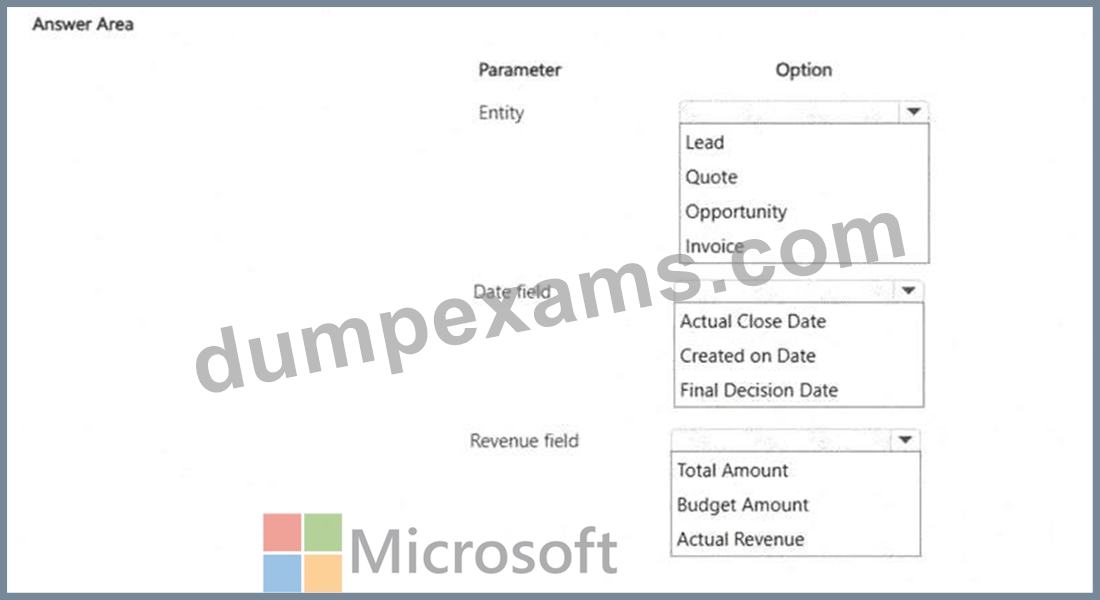
Answer:
Explanation: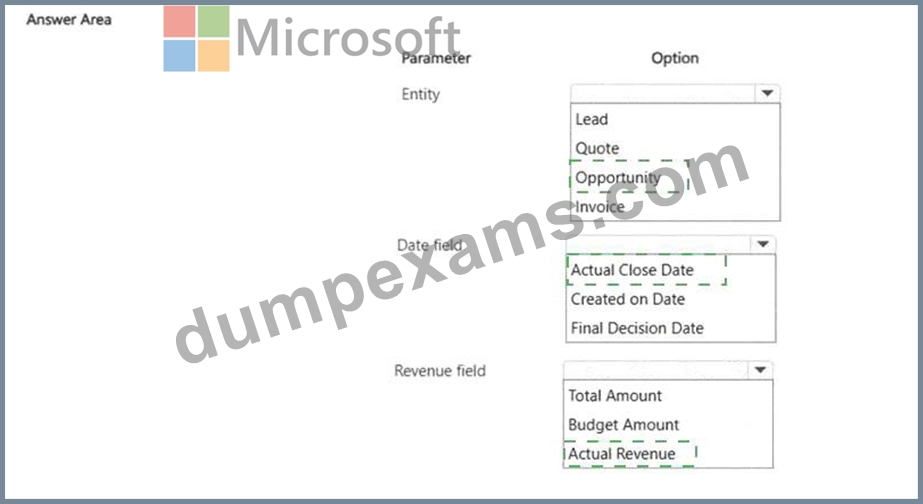
Explanation:
Parameter
Option
Entity
Opportunity
Date field
Actual Close Date
Revenue field
Actual Revenue
The correct table is Opportunity because the goal measurement is based on deal amounts when opportunities are closed. In Dynamics 365 Sales goal metrics, rollup fields define which table and source attribute are used to calculate actual or in-progress goal values. Microsoft's goal metric documentation gives the direct example of using the Opportunity table with the opportunity actual value/source attribute to track actual money amounts from opportunities closed as Won .
The correct date field is Actual Close Date because the goal period must be determined by when the deal was actually closed, not when the opportunity was created. Microsoft's goal metric configuration guidance states that the Date Field determines the goal period that records roll up into, and gives Actual Close Date as the relevant example.
The correct revenue field is Actual Revenue because the requirement is based on the total deal amount upon closing the opportunity. Budget Amount and Total Amount do not represent the final closed deal value for goal actuals. Goal rollup fields calculate actual performance values for completed measurable results, which fits closed opportunity revenue.
References/topics: Dynamics 365 Sales goals; goal metrics; rollup fields; opportunity actual revenue; actual close date; sales performance tracking.
NEW QUESTION # 19
A sales manager wants AI-generated forecasts but also requires representatives to adjust projections when unique business circumstances exist. Which statement is correct?
- A. AI forecasts cannot use CRM data.
- B. AI forecasts eliminate manual forecasting.
- C. Manual adjustments are still supported.
- D. Forecasts only use Excel spreadsheets.
Answer: C
Explanation:
Dynamics 365 forecasting combines AI-generated insights with seller expertise. Representatives and managers can review predicted outcomes and manually adjust forecasts when exceptional circumstances or business knowledge justify modifications beyond AI recommendations.
NEW QUESTION # 20
A company uses the Sales Close Agent in Dynamics 365 Sales to help sellers close deals.
The sales managers want to ensure the agent is used only in specific scenarios.
You need to identify the behavior of the Sales Close Agent.
What should you use to review the agent's behavior?
- A. Configure the opportunity pipeline view under App settings to display the agent's See full research page in the side panel for every opportunity.
- B. Open the Sales agent runs table to review the opportunity research results and recommendations for the Sales Close Agent in Research mode.
- C. Open a researched opportunity and choose See full research to open the Opportunity research page with complete agent insights and recommendations.
- D. Open the underlying opportunities from the Forecast section to access the agent's My top opportunities from the AI agent list.
Answer: C
Explanation:
The correct answer is C. To review the Sales Close Agent behavior for an opportunity, you open an opportunity researched by the agent and select See full research. Microsoft's current Dynamics 365 Sales documentation describes this flow: sellers open the My top opportunities from AI agent view, open an opportunity, review the summary section, and then select See full research to open the Opportunity research page, which contains the complete research insights and recommendations.
This page is the right place to understand what the agent is surfacing and why it is helping progress deals. The Opportunity research page includes deal importance, deal risks and mitigations, deal overview, key signals, and other research-driven insights.
NEW QUESTION # 21
A company plans to implement AI capabilities in Dynamics 365 Sales to automate multiple seller workflow tasks.
The company needs to assign AI capabilities that provide the following:
. Must identify contextual insights about accounts before outreach.
. Must generate overviews of opportunity activities and emails.
. Must evaluate and qualify incoming leads automatically.
You need to match the appropriate AI capability to each seller workflow task.
Which configuration should you use? To answer, select the appropriate options in the answer area.
NOTE: Each correct selection is worth one point.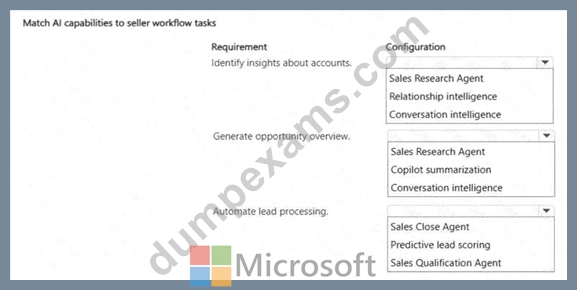
Answer:
Explanation: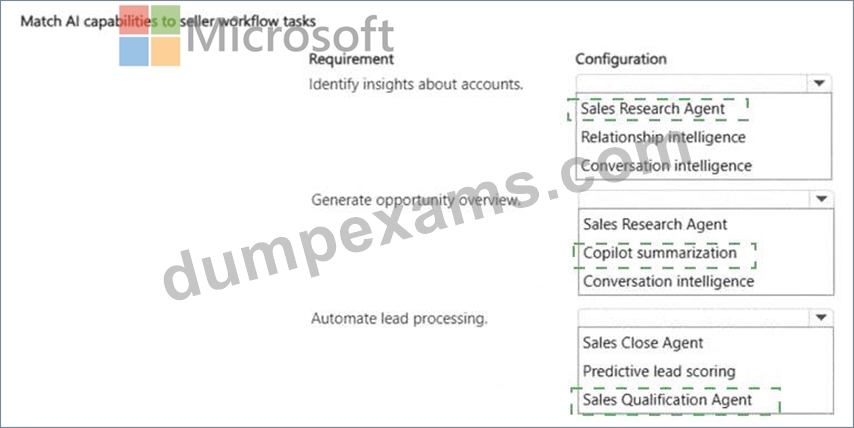
Explanation:
Requirement
Configuration
Identify insights about accounts
Sales Research Agent
Generate opportunity overview
Copilot summarization
Automate lead processing
Sales Qualification Agent
The correct capability for identifying contextual account insights before outreach is Sales Research Agent .
This agent is designed to help sellers and sales leaders gather AI-generated research about customers, prospects, and sales targets, which directly supports pre-outreach preparation and account intelligence. It is not Conversation Intelligence, because Conversation Intelligence analyzes calls and seller-customer conversations after or during interactions, not account research before outreach.
For generating an opportunity overview, the correct capability is Copilot summarization . Copilot in Dynamics 365 Sales can generate quick summaries of opportunity and lead records, including relevant activity and communication context, so sellers can quickly understand the state of a deal without manually reviewing all historical interactions.
For automating lead processing, the correct capability is Sales Qualification Agent . This agent evaluates incoming leads against qualification criteria, researches lead context, determines fit, and can qualify or disqualify leads according to configured business rules. Predictive lead scoring prioritizes leads by likelihood to convert, but it does not perform autonomous lead qualification processing. Sales Close Agent is focused on opportunity/deal execution, not lead qualification.
References/topics: Sales Research Agent; Copilot record summarization; Sales Qualification Agent; AI- driven seller workflow automation; Dynamics 365 Sales AI capabilities.
NEW QUESTION # 22
A company is using Dynamics 365 Sales and Microsoft 365.
The company has the following requirements for sales representatives:
- Must store opportunity files in a central location.
- Must collaborate using chat conversations associated with sales
records.
You need to configure the required integrations.
Which two integrations should you configure? Each correct answer presents part of the solution.
Choose two.
NOTE: Each correct selection is worth one point.
- A. Enable Teams conversation collaboration.
- B. Enable OneNote integration.
- C. Enable conversation intelligence for collaboration.
- D. Configure SharePoint document management.
- E. Configure server-side synchronization with Exchange Online.
Answer: A,D
Explanation:
The correct integrations are SharePoint document management and Teams conversation collaboration. SharePoint document management is required because the company wants opportunity files stored in a central location. Microsoft's Dynamics 365 Sales SharePoint integration is specifically designed to store documents related to Sales records in SharePoint while allowing users to access, share, and manage those documents from the Sales app.
Opportunity is one of the standard Sales records supported for SharePoint document integration.
Teams conversation collaboration is required because sellers must collaborate using chat conversations associated with sales records. Microsoft's Teams chat integration for Dynamics
365 Sales lets sellers start a new Teams chat or connect an existing chat directly to a Sales record, so conversations remain associated with the relevant opportunity, lead, account, or other record.
OneNote integration is for note-taking, not centralized file storage. Conversation intelligence analyzes calls and seller conversations for coaching and insights; it is not the feature for record- linked chat collaboration. Server-side synchronization with Exchange Online supports email, appointments, contacts, and tasks synchronization, but it does not satisfy the SharePoint file storage or Teams chat association requirements.
NEW QUESTION # 23
A seller asks Copilot to identify important customer concerns discussed across multiple emails before preparing a proposal. Which capability should be used?
- A. Goal Management
- B. Conversation summarization
- C. Duplicate detection
- D. Forecast recalculation
Answer: B
Explanation:
Conversation summarization analyzes multiple email exchanges to identify recurring concerns, commitments, questions, and discussion themes. Sellers receive a concise overview that helps them prepare proposals aligned with customer priorities and expectations.
NEW QUESTION # 24
Hotspot Question
A sales manager wants to set up goals for all salespeople. The goal measurement is based on the total outgoing calls finished each year. The goals for the fiscal year are based on a calendar year, January-December.
You need to create the rollup query for the goal metrics.
Which option should you select? To answer, select the appropriate options in the answer area.
NOTE: Each correct selection is worth one point.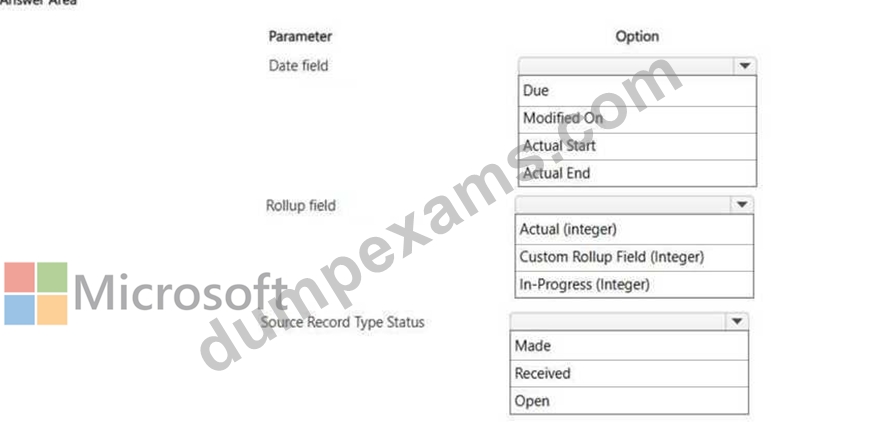
Answer:
Explanation: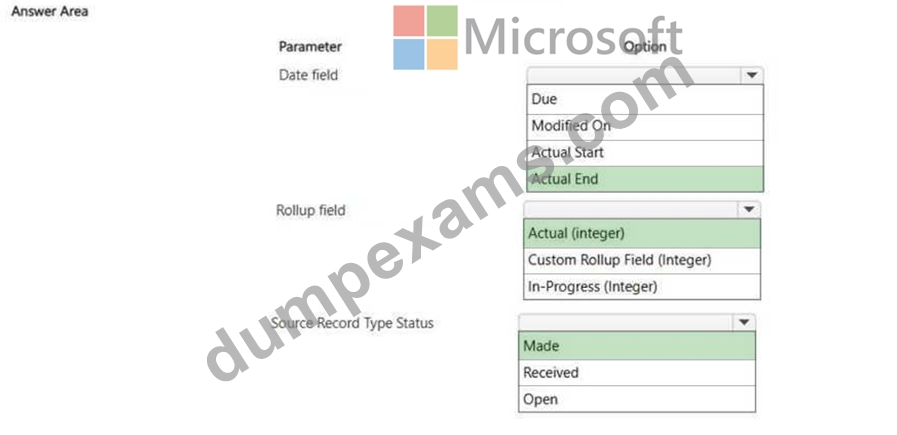
Explanation:
The correct date field is Actual End because the goal is based on calls that are finished during the calendar year. For the Phone Call table, Microsoft defines Actual End as the actual end date and time of the phone call, which is the proper date to evaluate whether the completed call falls within the January-December goal period.
The correct rollup field is Actual (Integer) because the goal measures the number of outgoing calls, not revenue or another money-based amount. Microsoft's goal metric guidance explains that goal metrics can use count/integer values, and specifically gives sales calls made by a salesperson as an example of an integer goal metric. The actual integer field represents the achieved count as of the latest rollup calculation.
The correct source record type status is Made because the requirement is for outgoing calls that were completed. Microsoft's Phone Call status reason options include Open, Made, Canceled, and Received; "Made" represents completed outgoing phone calls, while "Received" represents completed incoming calls. Therefore, the rollup must count Phone Call records with status Made, using Actual End as the date boundary and Actual (Integer) as the accumulated value.
NEW QUESTION # 25
A company wants AI recommendations without replacing existing sales methodologies or approval processes. Which statement best reflects Dynamics 365 Sales AI?
- A. AI eliminates manager involvement.
- B. AI replaces CRM configuration.
- C. AI removes approval workflows.
- D. AI complements existing sales processes.
Answer: D
Explanation:
Dynamics 365 Sales AI is designed to enhance existing sales methodologies by providing recommendations, predictions, and automation. Organizations continue using their established approval processes, governance, and CRM configurations while benefiting from AI-assisted productivity.
NEW QUESTION # 26
You configure Dynamics 365 Sales for a company.
Sales managers require sellers to use a structured lead qualification process before converting leads to opportunities.
You need to ensure sellers use a structured lead qualification process.
What should you configure?
- A. Lead assignment rules
- B. Lead activity timeline
- C. Sales accelerator
- D. Business process flow
- E. Predictive lead scoring
Answer: D
Explanation:
The correct configuration is Business process flow . A structured lead qualification process requires sellers to move through defined stages and steps before a lead is converted into an opportunity. Microsoft describes business process flows as a way to guide users through stages of sales, marketing, or service processes toward completion. Business process flows can also include branching logic and defined steps, which makes them the correct mechanism for standardizing how sellers qualify leads before conversion.
The other options do not enforce a structured qualification path. Sales accelerator helps prioritize seller activities and guide daily work, but it is not the core process-control mechanism for lead qualification. Lead activity timeline displays activities, emails, notes, and interactions; it does not define qualification stages.
Lead assignment rules route leads to sellers or teams, but they do not structure the seller's qualification steps. Predictive lead scoring helps prioritize leads by likelihood to qualify, but it does not require sellers to complete a defined qualification process. Therefore, to make sellers follow a controlled lead qualification sequence before converting leads to opportunities, configure a Business process flow .
References/topics: Business process flows; lead qualification; structured sales process; lead-to- opportunity conversion; Dynamics 365 Sales process guidance.
NEW QUESTION # 27
A company uses Dynamics 365 Sales to manage opportunities using a custom form.
Sellers spend significant time manually reviewing information about opportunities before contacting customers.
You need to reduce the time required for reviewing opportunities.
What should you add to the form?
- A. Up next
- B. Predictive opportunity scoring
- C. Health score
- D. Opportunity summary
- E. Timeline highlights
Answer: D
Explanation:
The correct answer is Opportunity summary . The requirement is not to score the opportunity, show the next activity, or display health indicators; it is to reduce the seller's manual review effort before contacting the customer. Microsoft's Copilot capability for Dynamics 365 Sales provides AI-generated summaries for opportunity records so sellers can quickly understand key deal context, related activities, emails, and important history without reading the full timeline manually. Microsoft specifically states that Copilot record summarization generates concise summaries of key information from sales records such as opportunities, leads, and accounts.
Because the company uses a custom opportunity form , the opportunity summary widget must be added to that form. Microsoft's implementation guidance explicitly flags custom opportunity forms and asks whether the opportunity summary widget has been added, and the Copilot summary documentation notes that the opportunity summary widget is available by default on the standard form but must be added to custom forms.
Up next guides sellers to the next activity, Health score and Predictive opportunity scoring evaluate opportunity risk or likelihood, and Timeline highlights is narrower than the full AI-generated opportunity overview.
References/topics: Copilot opportunity summary; custom opportunity forms; AI-generated sales record summaries; seller productivity in Dynamics 365 Sales.
NEW QUESTION # 28
A company plans to implement Dynamics 365 Sales and wants to design a Dataverse data model that supports AI-driven insights across the sales lifecycle.
The company must be able to track the progression of a deal from initial prospect identification through to finalized billing.
The data model must support the following requirements:
. Prospects must be captured before they become qualified sales deals.
. Qualified deals must support forecasting and pipeline analysis.
. Sales teams must be able to generate pricing proposals for customers.
. Accepted proposals must transition into fulfillment records and then final billing records.
You need to design the Dataverse table model that supports the required sales lifecycle.
Which table relationship should you implement?
- A. Convert leads into opportunities that generate quotes and then convert them into orders and invoices.
- B. Convert opportunities into leads that generate quotes and then finalize them as invoices and orders.
- C. Convert leads directly into quotes that generate opportunities before creating orders.
- D. Convert opportunities directly into orders and invoices before generating quotes.
- E. Convert leads into opportunities that generate quotes and then convert them directly into invoices without creating orders.
Answer: A
Explanation:
The correct sales lifecycle is Lead # Opportunity # Quote # Order # Invoice . In Dynamics 365 Sales, a lead captures an initial prospect before the person or organization is qualified. Microsoft's sales process guidance explains that sellers generally work with leads during the qualifying stage, and the goal is to qualify and advance the lead to the next stage of the sales process. Once qualified, the deal becomes an opportunity , which is the record used for pipeline tracking, revenue estimation, sales stages, probability, and forecasting analysis. Microsoft's prospect-to-quote guidance states that Dynamics 365 Sales supports capturing, managing, scoring, and converting leads into opportunities when qualification criteria are met.
Quotes are then created from opportunities to present pricing proposals to customers. Microsoft states that quotes created from opportunities are prefilled with opportunity details and products. Once the proposal is accepted, the quote can be converted into a sales order for fulfillment and then into an invoice for billing; Microsoft's quote/order/invoice process sample explicitly demonstrates converting an opportunity to a quote, a quote to a sales order, and a sales order to an invoice. Therefore, option B is the only sequence that correctly supports the full sales lifecycle.
References/topics: Lead management; opportunity pipeline; quote creation; order fulfillment; invoice billing; Dataverse Sales tables.
NEW QUESTION # 29
You are configuring Dynamics 365 Sales for a company.
Sales leadership wants to track monthly revenue targets for each seller and evaluate whether targets are achieved.
The configuration must include the following:
Define measurable sales targets.
. Aggregate opportunity revenue.
You need to configure the system so that the sales performance can be measured using defined targets.
What should you configure for each requirement? To answer, select the appropriate options in the answer area.
NOTE: Each correct selection is worth one point.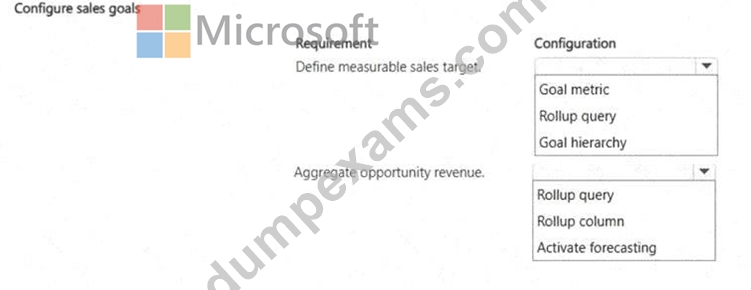
Answer:
Explanation: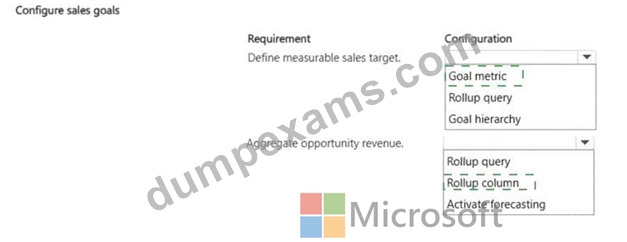
Explanation:
Requirement
Configuration
Define measurable sales target
Goal metric
Aggregate opportunity revenue
Rollup column
The correct configuration for defining measurable sales targets is Goal metric . In Dynamics 365 Sales, goals are measured by using goal metrics, which define what is being measured and how performance is calculated.
Microsoft's goal documentation explains that goals help measure progress toward targets such as revenue, while goal metrics and their rollup fields define the values used to calculate performance against those targets.
To aggregate opportunity revenue, use the Rollup column . A goal metric uses rollup fields/columns to calculate actual, in-progress, or custom values. Microsoft specifically describes a money-based goal metric that uses the Opportunity table and the opportunity actual revenue field to track money amounts from opportunities closed as won. This matches the requirement to aggregate opportunity revenue for monthly seller targets. Rollup query is not the best answer because it only adds filtering criteria to an existing goal metric, such as limiting records by owner, territory, or other conditions; it does not define the revenue aggregation itself. Goal hierarchy organizes parent-child goals, and forecasting supports pipeline projections, but neither defines the measurable target calculation or aggregates opportunity revenue for goal achievement.
References/topics: Dynamics 365 Sales goals; goal metrics; rollup columns/fields; opportunity revenue aggregation; seller revenue target tracking.
NEW QUESTION # 30
A company is using AI agents in Dynamics 365 Sales.
The company requires that the agent must do the following:
- Research incoming leads and generate initial outreach email.
- Autonomously contact leads, follow up, and evaluate qualification
during the process.
You need to identify which AI agent in Sales supports these requirements.
Which agent type should you use?
- A. Sales Close Agent: Research
- B. Sales Qualification Agent: Research and engage
- C. Sales Close Agent: Engage
- D. Sales Qualification Agent: Research-only
Answer: B
Explanation:
The correct agent type is Sales Qualification Agent: Research and engage. The requirement is specifically about inbound lead processing: researching incoming leads, generating outreach, autonomously contacting leads, following up, and evaluating qualification during the engagement process. Microsoft defines Sales Qualification Agent as the AI agent used to automate lead qualification in Dynamics 365 Sales, especially for high-volume inbound leads from sources such as websites, events, and webinars. In Research and engage mode, the agent researches the lead, evaluates fit using target customer profile and BANT criteria, sends personalized outreach emails, engages based on responses, sends follow-up emails, detects positive intent, and then hands promising leads to sellers.
Research-only mode is not enough because it generates a draft outreach email for seller review but does not send outreach emails or detect positive intent from responses. Microsoft's mode comparison explicitly shows that BANT checking, sending outreach, detecting positive intent, and follow-up emails are available in Research and engage mode, not Research-only mode. Sales Close Agent options are wrong because they apply to opportunity/deal execution, not initial lead qualification.
NEW QUESTION # 31
You are creating a business process flow named " Onboard new pet " to support onboarding of new clients for a pet care business.
A partially completed business process flow is shown in the following exhibit.
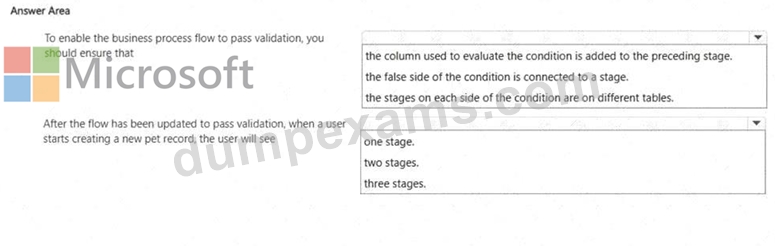
Use the drop-down menus to select the answer choice that completes each statement based on the information presented in the exhibit.
NOTE: Each correct selection is worth one point.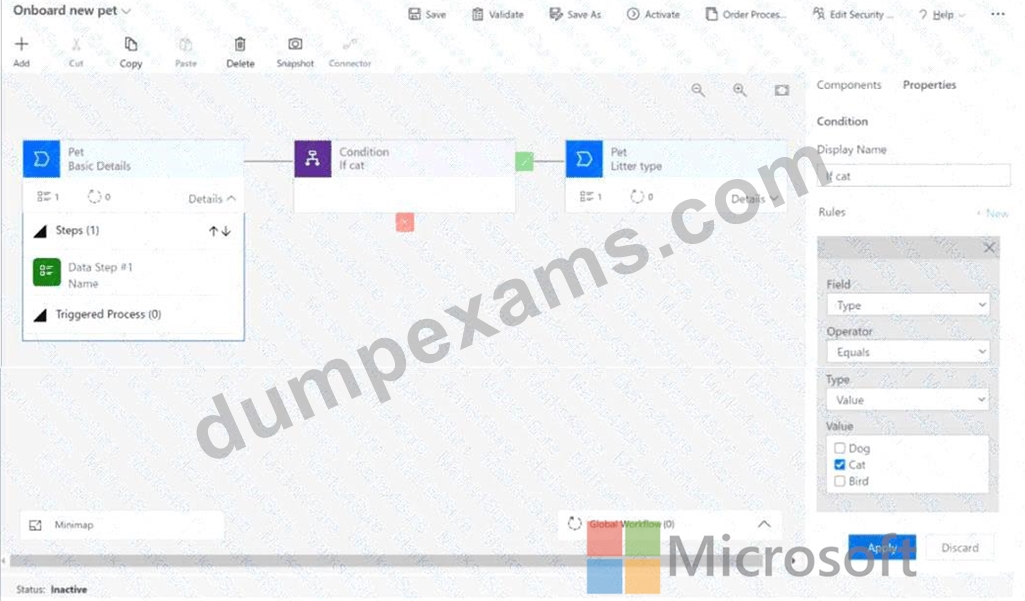
Answer:
Explanation: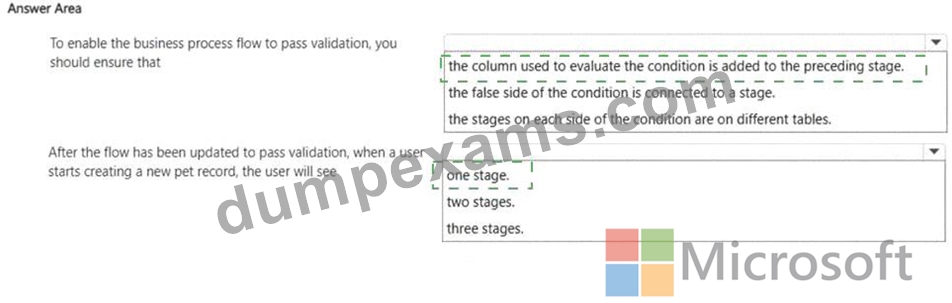
Explanation:
Statement
Correct selection
To enable the business process flow to pass validation, you should ensure that the column used to evaluate the condition is added to the preceding stage.
After the flow has been updated to pass validation, when a user starts creating a new pet record, the user will see one stage.
The condition in the business process flow evaluates the Type column to determine whether the pet is a Cat .
However, the preceding stage, Basic Details , only contains the Name step. In a business process flow, a branching rule must be based on steps in the stage immediately before the condition. Microsoft's business process flow design guidance states that branching rules must be based on the steps in the preceding stage, so the Type column must be added as a step in the Basic Details stage before the condition can validate correctly.
After validation is corrected, a user who starts creating a new pet record will initially see one stage : Basic Details . The Litter type stage is conditional and appears only when the Type value satisfies the rule, meaning the pet type equals Cat. Microsoft explains that branch selection is automatic and happens in real time based on the rules defined in the process definition. Until the user enters a Type value that satisfies the condition, the cat-specific branch is not part of the visible process path.
References/topics: Business process flows; conditional branching; preceding-stage steps; process validation; model-driven app process bar.
NEW QUESTION # 32
Case Study 1 - AdventureWorks
Background
AdventureWorks Cycles is a global manufacturer of high-performance bicycles headquartered in Seattle. The company sells products through distributors, specialty retailers, and a growing direct- to-consumer online channel. AdventureWorks Cycles recently expanded its product catalog to include the athlete package. This package includes a cycle, connected devices and subscription- based analytics services.
To support this expansion, the company wants to modernize its sales operations by implementing Microsoft Dynamics 365 Sales. The leadership team wants sellers to focus on building relationships with distributors and enterprise buyers rather than manually qualifying leads or assembling product packages.
The sales operations team is responsible for configuring the Dynamics 365 Sales environment.
Their goal is to implement Al-driven processes that streamline the lead-to-cash workflow while ensuring that sellers can easily identify the most promising opportunities.
Current Environment
AdventureWorks Cycles previously used a legacy CRM system that tracked leads and opportunities but lacked predictive intelligence or automated lead qualification. Sellers manually evaluate incoming leads, which creates delays and inconsistent prioritization.
The global sales team manages approximately 15,000 leads per month generated from marketing campaigns, trade shows, and partner referrals.
Product data is stored in multiple systems. Product managers maintain products and pricing in spreadsheets. Information regarding custom relationships, competitor analysis, and region- specific marketing content is stored in a SharePoint site called the sales portfolio.
The organization has identified several challenges they want to resolve with a new solution:
Sellers often spend significant time researching leads that ultimately do not convert.
Regional managers require in-depth reporting using information from the sales pipeline and seller activities, the point-of-sale solution, website analytics, and the accounting system.
Multiple product offerings are difficult to manage because components are defined in different systems.
Team leads require real-time information on active opportunities, as well as visibility of seller's appointments and phone calls, without needing to navigate into multiple views.
All sellers are assigned Dynamics 365 Sales Enterprise licenses, Also, the CFO has requested that Copilot message packs are pre-purchased by using the Copilot Studio subscription license.
A Dynamics 365 sales sandbox environment has been in use for six months. There are 60 leads records with 30 records that are qualified and 20 that are disqualified. Ten of the qualified leads are over three months old.
Business Requirements:
AdventureWorks Cycles has defined the following business requirements for the production environment of Dynamics 365 Sales:
Sellers in all regions should be able to review the new mountaineer cycles. The cycles include economy and premium fittings. When creating opportunities, sellers should be able to select a metal type when adding a mountaineer cycle to an opportunity. The metal types include chrome, aluminum, and titanium.
Pricing managers must be able to create deals for the same products in their own currencies and at their own prices, without reference to the cost of the product.
Sellers must be able to quickly view their own opportunities by phase.
Predictive scoring should be enabled for leads created within the last three months in the sandbox environment. This should provide seller training on the scoring's interpretation and usage.
A segment of leads named Hot is needed that will contain all leads where the source is phone, employee referral or partner. Leads from this segment should be distributed to sellers by using a round robin method.
Agents should not be able to take action on any data that is created in the production environment before they are started.
All sellers should be able to access disqualified leads.
Technical Information and Requirements:
The new Dynamics 365 Sales environment must meet the following technical requirements:
Agents must use a dedicated service identity to execute write actions with a controlled security role in Dataverse.
The sales operations team lead must be assigned the Power Platform administrator role.
The lead pricing manager must be assigned to the Microsoft 365 billing admin role.
The vice president of sales must be assigned the Al admin role.
A sandbox and a production environment must be created. Both of the environments must be enabled for Al capacity, but usage should be capped on the sandbox environment.
A trial environment must be created, with the Sales Qualification Agent configured to business requirements.
Sellers must be assigned the security roles on the production environment only.
All sellers must be assigned a customized version of the salesperson role. This role should grant read access only to the leads that the sellers own.
The EnableRoleBasedSystemViews property must be set to true for the production environment.
No Azure subscriptions are available in the tenant.
Issues:
During early testing, the sales operations team identify the following issues:
The Sales Qualification Agent has disqualified several leads in the trial environment. The vice president of sales has requested to understand the reason for the disqualified leads.
Sellers are unable to create agents in the production environment.
Agent consumption has been unreliable. The company requires that Al capacity is always available to sellers.
Hotspot Question
You need to configure the required billing for Copilot and agent capabilities.
What should you use for each requirement? To answer, select the appropriate options in the answer area.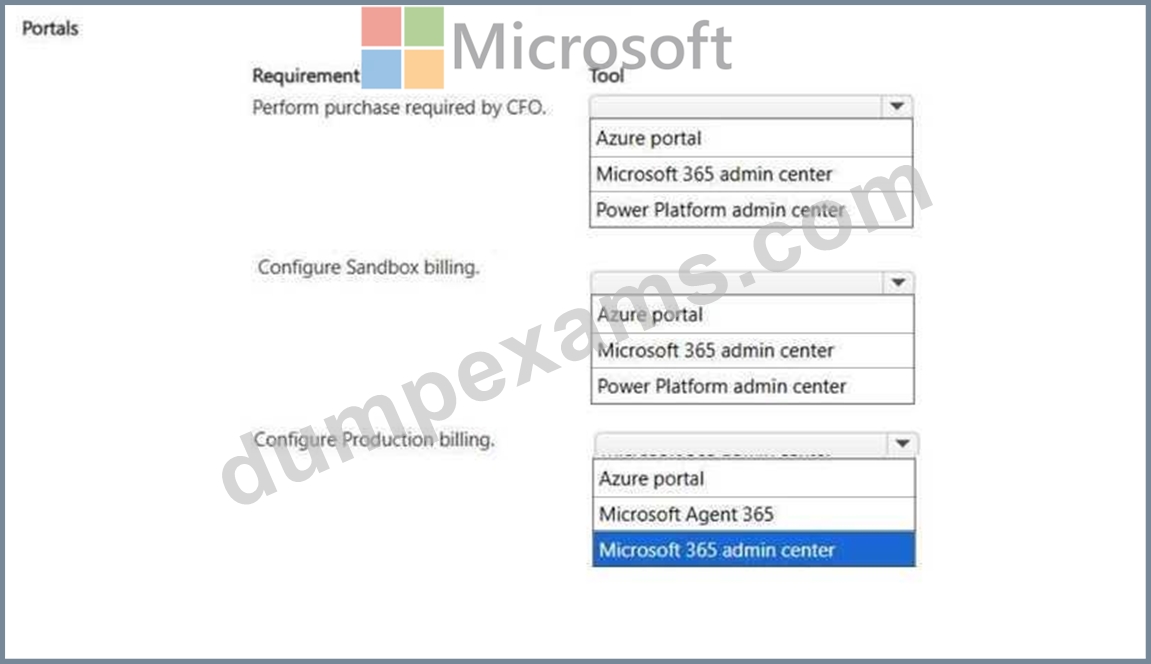
Answer:
Explanation: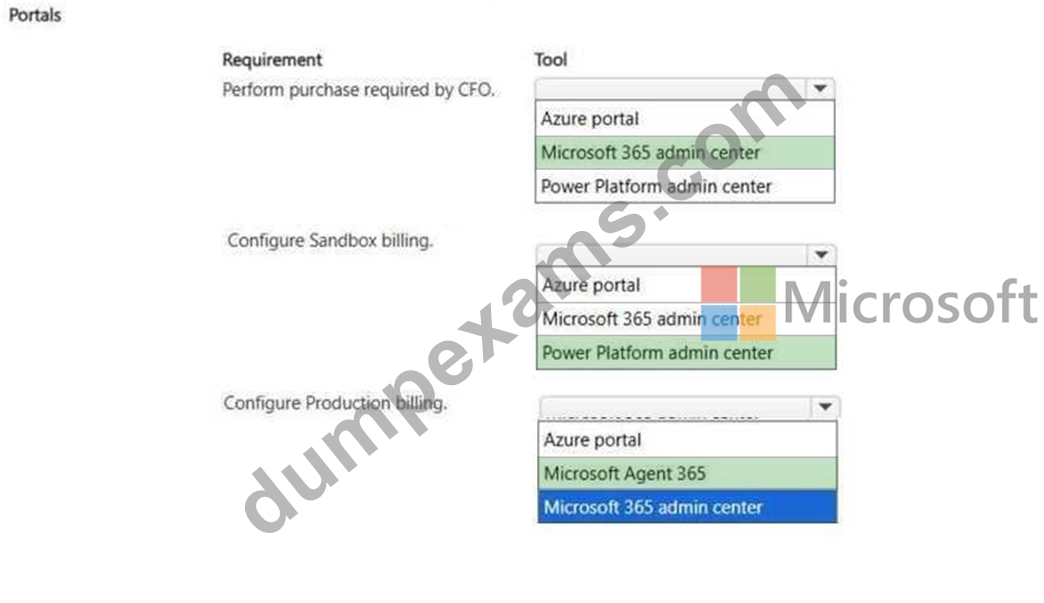
Explanation:
Why: Production requires reliable AI capacity so sellers are not blocked when prepaid Copilot capacity is depleted. The correct production setup is pay-as-you-go / billing policy configuration through the Microsoft 365 admin center. Azure portal is not the best answer here because the scenario says no Azure subscriptions are available, and Microsoft 365 admin center can be used for the billing policy workflow. Microsoft Agent 365 is for agent management/governance, not billing configuration.
NEW QUESTION # 33
......
We offers you the latest free online AB-210 dumps to practice: https://www.dumpexams.com/AB-210-real-answers.html