


[Jan 05, 2022] 1Z0-931-20 Practice Exam Dumps - 99% Marks In Oracle Exam
Updated Verified 1Z0-931-20 Q&As - Pass Guarantee or Full Refund
How to book Oracle 1Z0-931-20: Oracle Autonomous Database Cloud 2020 Specialist Exams
The registration for the 1Z0-931-20 Exam, please follow the steps given below:
- Step 1: Visit the Pearsonvue-Website
- Step 2: Through Pearson VUEâs scheduling platform, you will be able to choose a test center, time, and date
- Step 3: Search for the 1Z0-931-20 exam and purchase the exam by making payment using a credit/debit card
NEW QUESTION 40
For someone that is not a service administrator to use SQL Developer Web, what package would you need to use to give them access?
- A. SQLDEV_ADMIN.GRANT_SCHEMA
- B. ORDS_ADMIN.ENABLE_SCHEMA
- C. ORDS_ADMIN.GRANT_SCHEMA
- D. ORDS_PRIV.ENABLE_SCHEMA
Answer: C
NEW QUESTION 41
You have provisioned an Autonomous Data Warehouse (ADW) database with 16 enabled OCPUs and need to configure the consumer group for your application.
Which two are true when deciding the number of sessions for each application? (Choose two.)
- A. The HIGH consumer group can run 3 concurrent SQL statements when MEDIUM consumer group has
0 SQL statements - B. The HIGH consumer group can run up to 16 concurrent SQL statements as long as MEDIUM and LOW consumer groups have 0 SQL statements
- C. The HIGH consumer group can run up to 16 concurrent SQL statements in addition to 32 concurrent SQL statements in MEDIUM and LOW consumer group each
- D. The MEDIUM consumer group can run 20 concurrent SQL statements when HIGH consumer group has 0 SQL statements
- E. The MEDIUM and LOW consumer group can run up to 16 concurrent SQL statements if HIGH consumer group has 0 SQL statements
Answer: A,D
NEW QUESTION 42
Which two methods can you use to create users and grant roles in Autonomous Database services? (Choose two.)
- A. through SQLPIus
- B. through the Oracle Cloud Infrastructure service console
- C. through SQL/Developer s
- D. using DBMS_CLOUD_ADMIN package
Answer: A,C
Explanation:
https://oracle-base.com/articles/vm/oracle-cloud-autonomous-data-warehouse-adw-create-service
https://docs.oracle.com/en/cloud/paas/autonomous-data-warehouse-cloud/user/connect-sqlplus.html#GUID-A3005A6E-9ECF-40CB-8EFC-D1CFF664EC5A
https://docs.oracle.com/en/cloud/paas/autonomous-data-warehouse-cloud/user/connect-sql-dev.html#GUID-FB611317-2999-4C8C-8A3B-B3B3D3C5B417
https://docs.oracle.com/en/cloud/paas/autonomous-data-warehouse-cloud/user/dbms-cloud-admin.html#GUID-D76B229E-781E-45C0-9F14-CAF30F9E6E3B
NEW QUESTION 43
The Oracle Autonomous Database dedicated Exadata infrastructure feature is based upon which Oracle Cloud resources?
- A. Autonomous Exadata Infrastructure, Autonomous Backup, Autonomous Container Database, Autonomous Database
- B. Fleet Administrator, Database Administrator, Database User, Autonomous Exadata Infrastructure
- C. Virtual Cloud Network, Compartments, Policies, Autonomous Exadata Infrastructure
- D. Oracle Machine Learning Zeppelin Notebook, Autonomous Exadata Infrastructure, Fleet Administrator, Database Administrator,
Answer: D
NEW QUESTION 44
Which can be Scaled Independently of the number of CPUs In an Autonomous Database?
- A. Concurency
- B. Parallelism
- C. Sessions
- D. Storage
- E. Memory
Answer: D
NEW QUESTION 45
What are two security features enabled by default by the Autonomous Database? (Choose two.)
- A. SQL Net Encryption
- B. One SYSDBA account
- C. Read Only access to OS Audit logs
- D. Encrypted Database Links
- E. Transparent Data Encryption
Answer: A,E
Explanation:
In Autonomous Database, Oracle encrypt your data everywhere-whether in motion in SQL'Net traffic, and at rest in tablespaces and backups by default, each Autonomous Database service is automatically configured to use industry-standard TLS 1.2 to encrypt data in transit between the database service and clients or applications. Required client certificates and networking information are automatically packaged for the service consumer when the service is provisioned Oracle encrypt data at rest, by default the Autonomous Database is automatically encrypted using Oracle Transparent Data Encryption in tablespaces and backups
https://www.oracle.com/database/technologies/datawarehouse-bigdata/adb-faqs.html#SECURITY-BOOKMARK
https://docs.oracle.com/en/cloud/paas/atp-cloud/atpug/database-links.html#GUID-28F06977-300F-4599-AD97-2DEF67EF5FEA
NEW QUESTION 46
Which statement is true about connecting an OCI compute instance to a Shared Autonomous Database?
- A. The OCI compute instance can be used with an Always-Free Autonomous Database account.
- B. The Autonomous Database must be in the same VCN and Subnet as the Compute instance.
- C. The Autonomous Database must belong to a Network Security Group (NSG).
- D. A Private Endpoint is required to connect to the Shared-Autonomous Database.
- E. The OCI compute instance does not support connecting to a Shared Autonomous Database.
Answer: B
NEW QUESTION 47
An Autonomous Database (ADB) user with an instance wallet has left the company and they shared a database user id with other users when accessing ADB.
Other than changing the shared user password, what can the admin do to protect the instance?
- A. Rotate the instance wallet and share the new wallet with the remaining users.
- B. Shutdown and restart the instance.
- C. Delete the user.
- D. Trust the user who left to not access the database.
Answer: B
NEW QUESTION 48
Which three statements are correct when the Autonomous Database is stopped? (Choose three.)
- A. CPU billing is halted based on full-hour cycles of usage.
- B. Tools are no longer able to connect to a stopped instance.
- C. In-flight transactions and queries are stopped.
- D. User with DWROLE can still access the database.
Answer: A,B,C
Explanation:
https://docs.oracle.com/en/cloud/paas/autonomous-data-warehouse-cloud/user/autonomous-stop.html#GUID-9AF677F3-027A-43FD-B018-9F4A42D5CDE9
NEW QUESTION 49
Which Autonomous Database Cloud service ignores hints in SQL Statements by default?
- A. Autonomous Data Warehouse.
- B. Both services ignore hints by default.
- C. Autonomous Transaction Processing.
- D. Neither service ignores hints by default.
Answer: A
Explanation:
http://blog.umairmansoob.com/tag/oracle-autonomous-data-warehouse/
NEW QUESTION 50
Which three statements are true regarding how Autonomous Database provides data security? (Choose three.)
- A. Oracle automatically applies security updates to ensure data is not vulnerable to known attack vectors.
- B. Users are given OS logons or SYSDBA privileges to prevent phishing attacking.
- C. Network connections from clients to Autonomous Database are encrypted using the client credentials wallet.
- D. Data is encrypted at rest using transparent data encryption.
Answer: A,C,D
Explanation:
https://www.oracle.com/database/technologies/datawarehouse-bigdata/adb-faqs.html
NEW QUESTION 51
Which management operation is correct about Autonomous Databases on shared Exadata infrastructure?
- A. You can choose to use Release Update (RU) or Release Update Revision (RUR) updates for your about Autonomous Databases on shared Exadata infrastructure.
- B. You cannot configure the scheduling for your Autonomous Databases on shared Exadata infrastructure.
- C. You can perform a "rolling restart" on all the Autonomous Databases. During a rolling restart, each node of an Autonomous Database is restarted separately while the remaining nodes continue to be available.
- D. You can skip a scheduled maintenance run. For Autonomous Databases on shared Exadata infrastructure, you can skip maintenance runs for up to two consecutive quarters if needed.
Answer: C
NEW QUESTION 52
Which three tasks by default are taken care of by the Autonomous Database? (Choose three.)
- A. Application User Creation
- B. Backups
- C. Firmware Patching
- D. Data Loading
- E. Database Upgrades
Answer: C,D,E
Explanation:
http://www.oracle.com/us/products/database/autonomous-database-self-securing-5116048.pdf (6)
NEW QUESTION 53
When enabling auto-scaling, which three options do not change?
- A. Number of OCPUs displayed in the console.
- B. Amount of storage
- C. Level of concurrency
- D. I/O resources
- E. parallelism settings
Answer: C,E
NEW QUESTION 54
Which Autonomous Database Service is NOT used to connect to an Autonomous Transaction Processing instance?
- A. LOW
- B. TPPERFORMANT
- C. MEDIUM
- D. HIGH
- E. TPURGENT
Answer: B
Explanation:
Predefined Database Service Names for Autonomous Transaction Processing The tnsnames.ora file provided with the credentials zip file contains five database service names identifiable as tpurgent, tp, high, medium, and low. The predefined service names provide different levels of performance and concurrency for Autonomous Transaction Processing.
* tpurgent: The highest priority application connection service for time critical transaction processing operations. This connection service supports manual parallelism.
* tp: A typical application connection service for transaction processing operations. This connection service does not run with parallelism.
* high: A high priority application connection service for reporting and batch operations. All operations run in parallel and are subject to queuing.
* medium: A typical application connection service for reporting and batch operations. All operations run in parallel and are subject to queuing. Using this service the degree of parallelism is limited to four (4).
* low: A lowest priority application connection service for reporting or batch processing operations. This connection service does not run with parallelism.
https://docs.oracle.com/en/cloud/paas/atp-cloud/atpug/manage-priorities.html#GUID-80E464A7-8ED4-
45BB-A7D6-E201DD4107B7
NEW QUESTION 55
Which two options are available to restore an Autonomous Data Warehouse? (Choose two.)
- A. Select the backup from which restore needs to be done.
- B. Backup and recovery must be done using Recovery Manager(RMAN).
- C. Specify the point in time (timestamp) to restore.
- D. Select the snapshot of the backup.
- E. Select the archived redo logs.
Answer: A,C
Explanation:
In the Restore prompt, select Specify Timestamp or Select Backup to restore to a point in time or to restore from a specified backup.
https://docs.oracle.com/en/cloud/paas/autonomous-data-warehouse-cloud/user/backkup- recover.html#GUID-78C28C41-AA87-4AD7-BEB6-693235C73F3C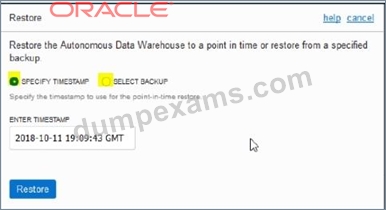
NEW QUESTION 56
The 3rd party application that your customer wants to migrate to Autonomous Database (ADB) has some specific demands like tablespace names, usemames and init.ora parameters. The decision was made to adhere to the suggested migration method using an instant client and the datapump version that was suggested (and came with it).
Which statement is true about the migration of the application's database success?
- A. The migration can be technically a success but the 3-rd party vendor needs to support the result.
- B. The suggested datapump version will create an alias for non-standard tablespace names so the migration is successful.
- C. The migration can be a success, both technically and functional due to datapump enhancements.
- D. The tablespace names will result in a blocking error during datapump import because of ADB limitations.
Answer: C
Explanation:
https://docs.oracle.com/en/cloud/paas/autonomous-data-warehouse-cloud/user/load-data-data-pump.html#GUID-9F6B551A-9DB7-44BE-A8ED-08E300C56DB1
NEW QUESTION 57
What are two differentiators of Oracle Autonomous Database Dedicated Infrastructure?
- A. Users can customize the maintenance schedule.
- B. Users have OS access to the database machine.
- C. It offers greater control and isolation starting at the Exadata cloud infrastructure level.
- D. Users have SYS privileges in the database.
- E. Users can customize the OS stack and add additional packages
Answer: C,D
NEW QUESTION 58
Which statement is correct with respect to required action to move Autonomous Database resources to a different compartment?
- A. Moving an Autonomous Database instance does not include its automatic backups.
- B. Autonomous Exadata Infrastructure instances and Autonomous Container Databases have no dependent resources that move with them. Associated (non-dependent) resources remain in their current compartments.
- C. Moving the compartment of the Autonomous Database will also move the Autonomous Container Database and Autonomous Exadata Infrastructure.
- D. You do not need to have sufficient access permissions on the compartment that the resource is being moved to.
Answer: B
NEW QUESTION 59
In which way can a SQL Developer help you test your data loading scenario to Autonomous Database (ADB)?
- A. In the Column Definition Phase, the system cross-references with the file-contents and shows the conflicts with the definition.
- B. In the TEST phase, a temporary table will be populated with the records before inserting them in the destination table.
- C. In the TEST phase of the wizard a list is generated containing the records that would be rejected during import.
- D. In the TEST phase of the wizard, a subset of accepted records is displayed based on your definition.
Answer: D
Explanation: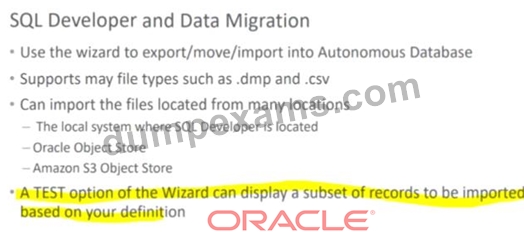
NEW QUESTION 60
How many pre-defined service names are configured in tnsnames.ora for a single Autonomous Transaction Processing database instance, and what are they called?
- A. Two. They are called ATP and ADW.
- B. Three. They are called high, medium and low.
- C. Five. They are called tpurgent, tp, high, medium and low.
- D. None. There are no pre-defined service names in tnsnames.ora.
Answer: C
Explanation:
https://docs.oracle.com/en/cloud/paas/atp-cloud/atpug/connect-predefined.html#GUID-9747539B-FD46-
44F1-8FF8-F5AC650F15BE
NEW QUESTION 61
While Autonomous Transaction Processing and Autonomous Data Warehouse use the same Oracle database, which statement is true about the workloads?
- A. Autonomous Transaction Processing workloads are optimized for data warehouse, data mart, and data lake.
- B. Autonomous Transaction Processing memory usage optimizes workloads for parallel joins and aggregations.
- C. Data that is bulk loaded, by default, uses the row format in Autonomous Transaction Processing where Autonomous Data Warehouse data format is columnar.
- D. Autonomous Data Warehouse workloads are optimized for mixed workloads.
Answer: C
Explanation:
- Both ADW and ATP share the Autonomous Database platform of Oracle Database on Exadata Cloud infrastructure.
The difference is how the services have been optimized within the database. When you start loading data into the autonomous database, we store the data in the appropriate format for the workload.
* If it is ADW, then we store data in columnar format because that's the best format for analytics processing.
* If it is ATP, then we store the data in row format because that's the best format for fast single row lookups.
- Oracle Autonomous Database is offered in two workload-optimized flavors
* Autonomous Data Warehouse (ADW), which has been optimized for analytic workloads * Autonomous Transaction Processing (ATP). ATP is optimized for transaction processing or mixed workload
https://docs.oracle.com/en/cloud/paas/atp-cloud/atpug/autonomous-intro-atp.html#GUID-B90147B2-EA04-4147-9606-0413D9CC1589
NEW QUESTION 62
What is the correct way to list all files in the default data pump directory?
- A. By executing select * from DBMS_CLOUD.LIST_FILES('DATA_PUMP_DIR');
- B. Log onto ADW server and issue is -al on the command line.
- C. By executing select * from utl_file . list ( 'DATA_PUMP_DIR ' ) ;
- D. You cannot list files in the default data pump directory from Autonomous Data Warehouse (ADW).
Answer: A
NEW QUESTION 63
......
The benefit of obtaining the Oracle 1Z0-931-20: Oracle Autonomous Database Cloud 2020 Specialist Exam Certification
The certification exam is designed to help the candidate excel and command his future progression. It is designed to:
1Z0-931-20 Certifications provide opportunities to get a job easily which they are interested in instead of wasting years and ending up without getting any experience.
1Z0-931-20 certified candidates will be confident and stand different from others as their skills are more trained than non-certified professionals.
1Z0-931-20 credential delivers higher earning potential and increased promotion opportunities because it shows a good understanding of database cloud management.
1Z0-931-20 Certification provides practical experience to candidates from all the aspects to be a proficient worker in the organization.
An Oracle 1Z0-931-20 Certification helps to build a sense of trust with current and future employers that you can perform the job.
1Z0-931-20 Certification is distinguished among competitors when you compare with non-certified individuals mainly while considering the interview.
Differentiate individual in a crowded job market
Empower individuals to execute tasks with confidence and skill
Provide individuals with a mark of excellence that is extremely recognized by the clients and sought within across the industry.
1Z0-931-20 exam test provide proven knowledge to use the tools to complete the task more efficiently and cost-effectively than other non-certified professionals.
Difficulty in writing the Oracle 1Z0-931-20: Oracle Autonomous Database Cloud 2020 Specialist Exam
1Z0-931-20 Certification is one of the basic levels of certification in the Oracle cloud. It is primarily intended for individuals who come from a database cloud background and want to advance their knowledge of Oracle cloud. For the experienced database cloud management individual, this exam would be very easy, but for one who does not have much experience, 1Z0-931-20 Certification can be a challenging one. Dumpexams had designed their 1Z0-931-20 practice exams focusing on the entire course contents of this certification. Dumpexams are confident in the accuracy and legitimacy of 1Z0-931-20 exam dumps and in this manner. Candidates can easily pass the 1Z0-931-20 exam with genuine 1Z0-931-20 dumps provided by the Dumpexams. This course helps students to identify sub-quests, incorporate multi-questions with SET operators in a single query and report community functions on aggregate results. His chief audience are administrators, researchers, developers and system managers. The course teaches students how to observe key structural elements of Oracle database 12c, to collect data from tables in lines and columns, to manage schema objects, to produce SELECT statements, to use scalar and correlated sub-quests and much more. This course helps students to know how to perform Oracle Database 12c administrative and management related tasks. The audience includes the administrator, the administrator of the database. The course aims to instruct the candidate’s concepts of data competence and auditing, management of tablespaces and undo data, management of the Oracle Database 12c network connections, security and privileges, the understanding of the architecture of the oracle database, monitoring and implementation of the proactive data base instance.
1Z0-931-20 Real Valid Brain Dumps With 118 Questions: https://www.dumpexams.com/1Z0-931-20-real-answers.html