


[Nov 05, 2025] Pass JN0-637 Review Guide, Reliable JN0-637 Test Engine
JN0-637 Test Engine Practice Test Questions, Exam Dumps
NEW QUESTION # 58
How does an SRX Series device examine exception traffic?
- A. The device examines the host-inbound traffic for the ingress interface and zone.
- B. The device examines the host-inbound traffic for the egress interface and zone.
- C. The device examines the host-outbound traffic for the egress interface and zone.
- D. The device examines the host-outbound traffic for the ingress interface and zone.
Answer: A
Explanation:
Exception traffic, including management and control plane traffic, is handled by examining host- inbound traffic configurations at the ingress interface and zone. It ensures traffic reaches necessary services like SSH and IKE securely.
SRX Series devices handle exception traffic (such as management traffic like SSH, Telnet, DNS queries, etc.) differently than regular transit traffic. Exception traffic is examined based on host- inbound traffic for the ingress interface and zone. If traffic is destined for the device itself (e.g., management traffic or routing protocol messages), it must be allowed as host-inbound traffic on both the ingress interface and zone.
NEW QUESTION # 59
Your IPsec VPN configuration uses two CoS forwarding classes to separate voice and data traffic.
How many IKE security associations are required between the IPsec peers in this scenario?
- A. 0
- B. 1
- C. 2
- D. 3
Answer: B
NEW QUESTION # 60
Exhibit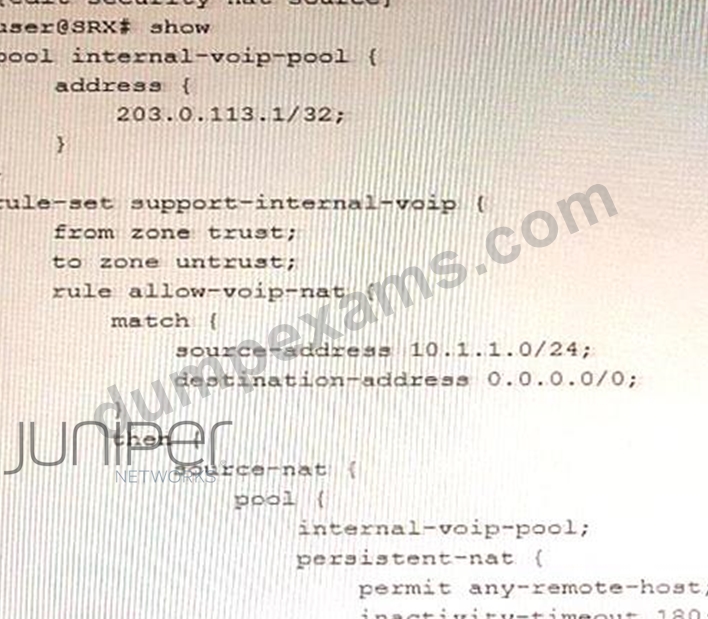
Referring to the exhibit, an internal host is sending traffic to an Internet host using the 203.0.113.1 reflexive address with source port 54311.
Which statement is correct in this situation?
- A. Any host on the Internet can initiate traffic to reach the internal host using the 203.0.113.1 address, a random source port, and destination port54311.
- B. Only the Internet host that the internal host originally communicated with can initiate traffic to reach the internal host using the 203.0.113.1 address, source port 54311, and a random destination port.
- C. Any host on the Internet can initiate traffic to reach the internal host using the 203.0.113.1 address, source port 54311, and a random destination port.
- D. Only the Internet host that the internal host originally communicated with can initiate traffic to reach the internal host using the 203.0 113.1 address, a random source port, and destination port 54311.
Answer: C
NEW QUESTION # 61
You configure two Ethernet interfaces on your SRX Series device as Layer 2 interfaces and add them to the same VLAN. The SRX is using the default L2-learning setting. You do not add the interfaces to a security zone.
Which two statements are true in this scenario? (Choose two.)
- A. The interfaces will not forward traffic by default.
- B. You are able to apply stateful security features to traffic that enters and exits the VLAN.
- C. You cannot add Layer 2 interfaces to a security zone.
- D. You are unable to apply stateful security features to traffic that is switched between the two interfaces.
Answer: A,D
Explanation:
When Ethernet interfaces are configured as Layer 2 and added to the same VLAN without being assigned to a security zone, they will not forward traffic by default. Additionally, because they are operating in a pure Layer 2 switching mode, they lack the capability to enforce stateful security policies.
When two interfaces are configured as Layer 2 interfaces and belong to the same VLAN but are not assigned to any security zone, traffic switched between them is handled purely at Layer 2.
Stateful security features, such as firewall policies, are applied at Layer 3, so traffic between these interfaces will not undergo any stateful inspection or firewalling by default.
In Junos, Layer 2 interfaces must be added to a security zone to allow traffic forwarding. Since the interfaces in this scenario are not part of a security zone, they will not forward traffic by default until assigned to a zone. This is a security measure to prevent unintended forwarding of traffic.
Juniper Security Reference:
NEW QUESTION # 62
Exhibit: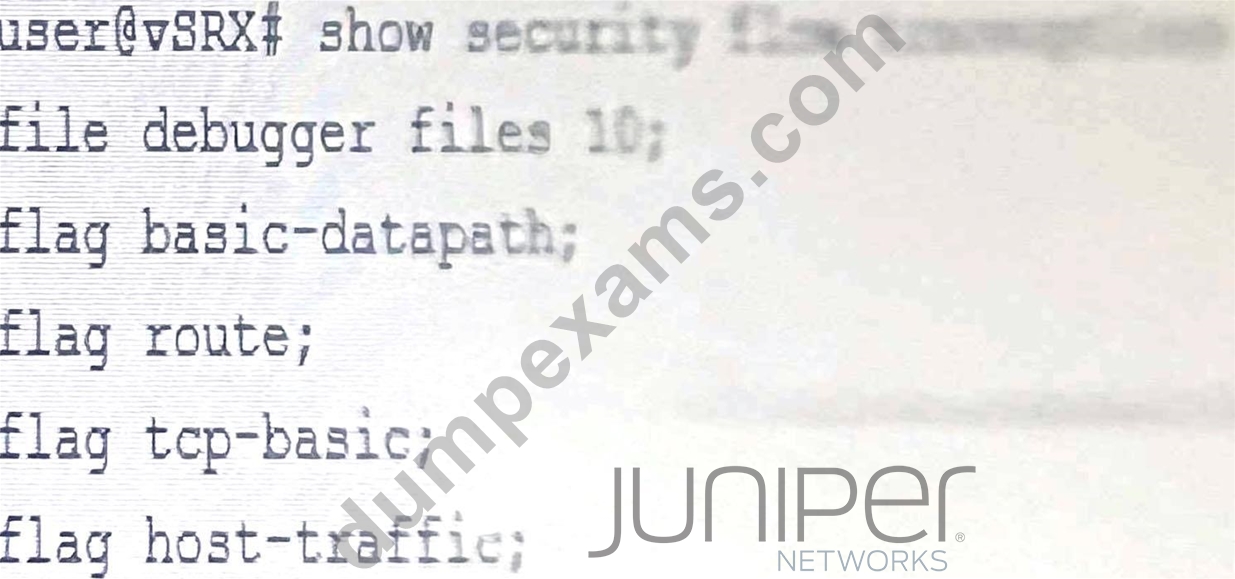
The security trace options configuration shown in the exhibit is committed to your SRX series firewall.
Which two statements are correct in this Scenario? (Choose Two)
- A. Once the trace has generated 10 log files, the trace process will halt.
- B. The file debugger will be readable only by the user who committed this configuration
- C. The file debugger will be readable by all users.
- D. Once the trace has generated 10 log files, older logs will be overwritten.
Answer: A,D
Explanation:
Once the trace has generated 10 log files, older logs will be overwritten. - This is generally true if the configuration includes a file count limit and the 'world-readable' flag. Without the 'world-readable' flag, only the file's owner or superuser can read the file. If the 'no-world-readable' flag is set, only the user that created the file and root can read it.
Once the trace has generated 10 log files, the trace process will halt. - This would be true only if the 'files' statement is used without the 'world-readable' or 'no-world-readable' flag. If 'no-world-readable' is set, the trace files are not readable by all users.
NEW QUESTION # 63
Referring to the flow logs exhibit, which two statements are correct? (Choose two.)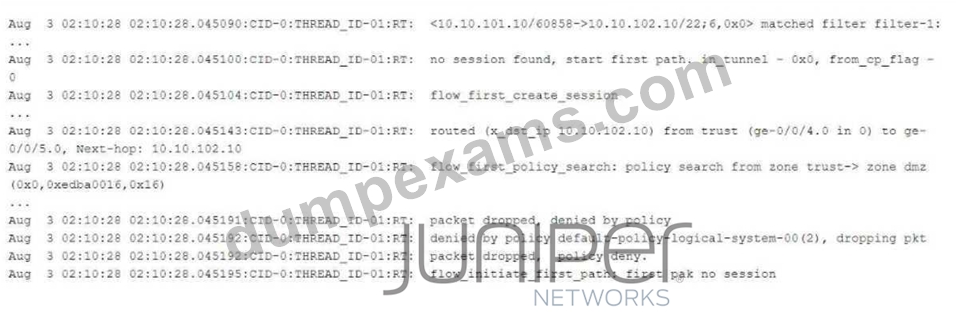
- A. The data shown requires a traceoptions flag of host-traffic.
- B. The data shown requires a traceoptions flag of basic-datapath.
- C. The packet is dropped by the default security policy.
- D. The packet is dropped by a configured security policy.
Answer: B,C
Explanation:
Understanding the Flow Log Output:
From the flow logs in the exhibit, we can observe the following key events:
The session creation was initiated (flow_first_create_session), but the policy search failed (flow_first_policy_search), which implies that no matching policy was found between the zones involved (zone trust-> zone dmz).
The packet was dropped with the reason "denied by policy." This shows that the packet was dropped either due to no matching security policy or because the default policy denies the traffic (packet dropped, denied by policy).
The line denied by policy default-policy-logical-system-00(2) indicates that the default security policy is responsible for denying the traffic, confirming that no explicit security policy was configured to allow this traffic.
NEW QUESTION # 64
Exhibit.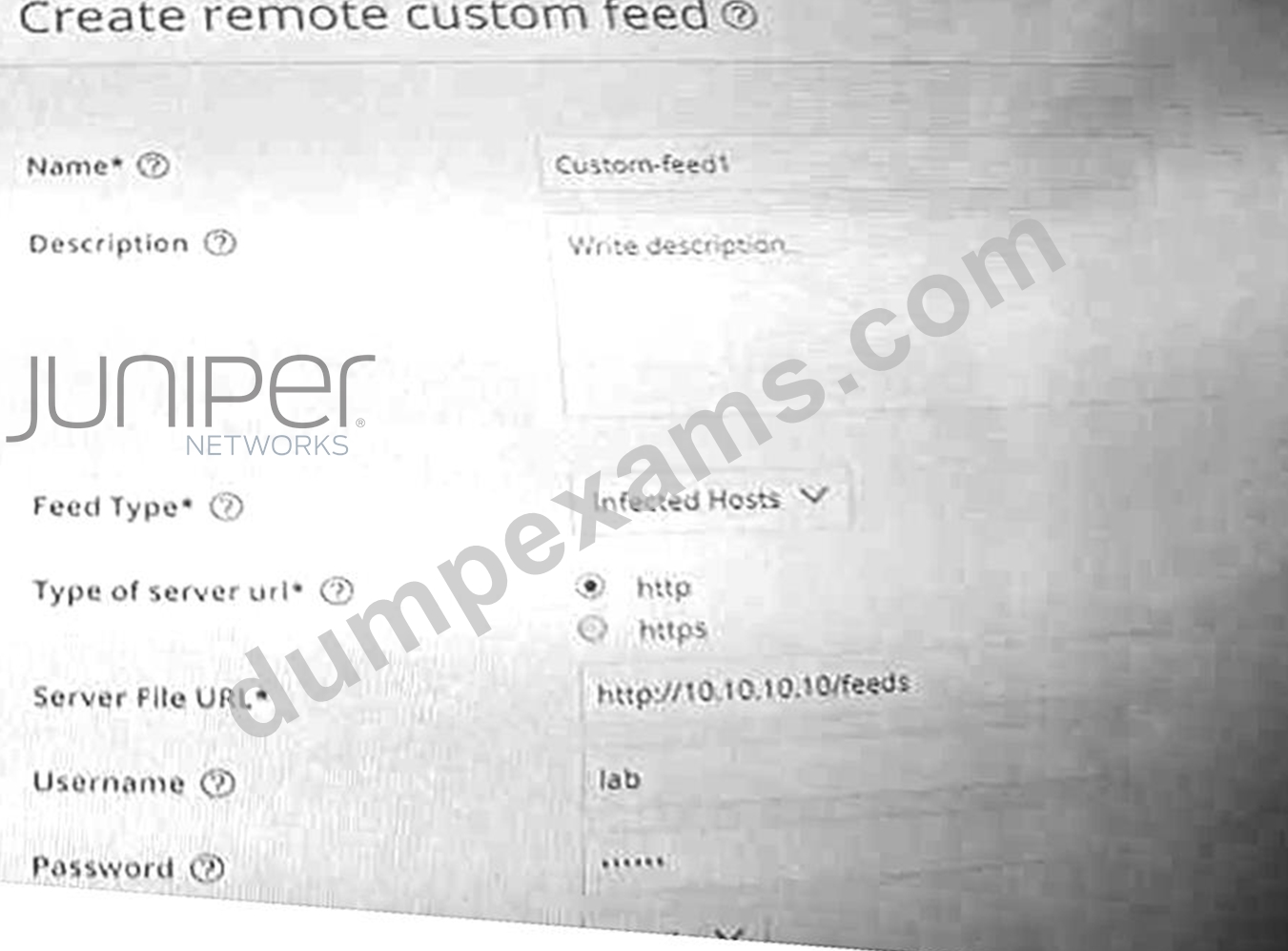
Referring to the exhibit, which two statements are true? (Choose two.)
- A. Juniper Networks will not investigate false positives generated by this custom feed.
- B. The custom infected hosts feed will not overwrite the Sky ATP infected host's feed.
- C. Juniper Networks will investigate false positives generated by this custom feed.
- D. The custom infected hosts feed will overwrite the Sky ATP infected host's feed.
Answer: A,B
Explanation:
Juniper Networks will not investigate false positives generated by this custom feed. - Typically, a vendor like Juniper Networks would not investigate false positives generated by a custom feed because the feed content is controlled by the customer, not Juniper.
The custom infected hosts feed will not overwrite the Sky ATP infected host's feed. - Custom feeds are generally additional to the feeds provided by a vendor's threat intelligence platform like Sky ATP. They are used to supplement the existing threat intelligence and do not overwrite it, but rather work alongside it.
NEW QUESTION # 65
Your Source NAT implementation uses an address pool that contains multiple IPv4 addresses Your users report that when they establish more than one session with an external application, they are prompted to authenticate multiple times External hosts must not be able to establish sessions with internal network hosts What will solve this problem?
- A. Enable persistent NAT
- B. Enable destination NAT.
- C. Enable address persistence.
- D. Disable PAT.
Answer: A
NEW QUESTION # 66
Exhibit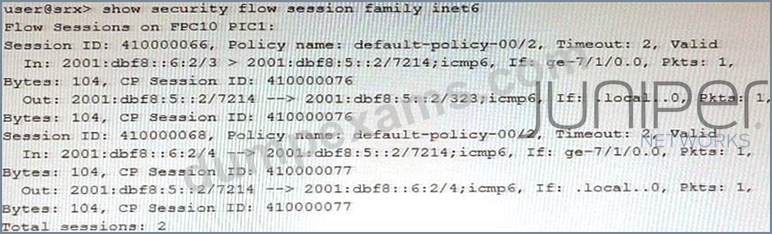
Which statement is true about the output shown in the exhibit?
- A. The SRX Series device is configured to disable IPv6 packet forwarding.
- B. The SRX Series device is configured with packet-based IPv6 forwarding options.
- C. The SRX Series device is configured with default security forwarding options.
- D. The SRX Series device is configured with flow-based IPv6 forwarding options.
Answer: C
NEW QUESTION # 67
You have configured the backup signal route IP for your multinode HA deployment, and the ICL link fails.
Which two statements are correct in this scenario? (Choose two.)
- A. The backup node changes the routing preference to the other node at its medium priority.
- B. The active node removes the active signal route.
- C. The active node keeps the active signal route.
- D. The current active node retains the active role.
Answer: A,D
Explanation:
Explanation:
NEW QUESTION # 68
Which two statements are correct about mixed mode? (Choose two.)
- A. IRB interfaces can be used to route traffic.
- B. IRB interfaces cannot be used to route traffic.
- C. Layer 2 and Layer 3 interfaces can use separate security zones.
- D. Layer 2 and Layer 3 interfaces can use the same security zone.
Answer: A,D
Explanation:
In mixed mode, both Layer 2 and Layer 3 interfaces can be configured to operate within the same security zone, allowing for flexible network segmentation. Additionally, Integrated Routing and Bridging (IRB) interfaces facilitate routing for Layer 2 bridged domains, allowing Layer 2 traffic to be forwarded at Layer 3.
For more information on mixed mode and IRB functionality, refer to Juniper's Mixed Mode and IRB Documentation.
* Explanation of Answer A (Layer 2 and Layer 3 in Same Zone):
* Inmixed modeconfigurations, it is possible to have both Layer 2 and Layer 3 interfaces within the same security zone. This allows for flexible design where different types of traffic can be handled by the same set of security policies.
* Explanation of Answer B (IRB Interfaces Can Route Traffic):
* IRB (Integrated Routing and Bridging)interfaces are used to route traffic between Layer 2 and Layer 3 domains. They can bridge traffic at Layer 2 and also provide Layer 3 routing capabilities within the same device. This allows for seamless interaction between Layer 2 and Layer 3 traffic in mixed mode.
Step-by-Step Configuration:
* Configuring Layer 2 and Layer 3 in the Same Security Zone:
* Assign both Layer 2 and Layer 3 interfaces to the same security zone as follows:
bash
Copy code
set security zones security-zone <zone-name> interfaces <interface-name>
* Configuring IRB Interface:
* To route traffic using the IRB interface:
bash
Copy code
set interfaces irb unit 0 family inet address <ip-address>
set security zones security-zone <zone-name> interfaces irb.0
Juniper Security Reference:
* IRB Interface Overview: IRB interfaces allow for both bridging and routing functionalities, making them essential in mixed-mode environments.
* Layer 2 and Layer 3 in the Same Zone: This feature provides flexibility in designingnetworks that combine both Layer 2 switching and Layer 3 routing under the same security policies.
NEW QUESTION # 69
Exhibit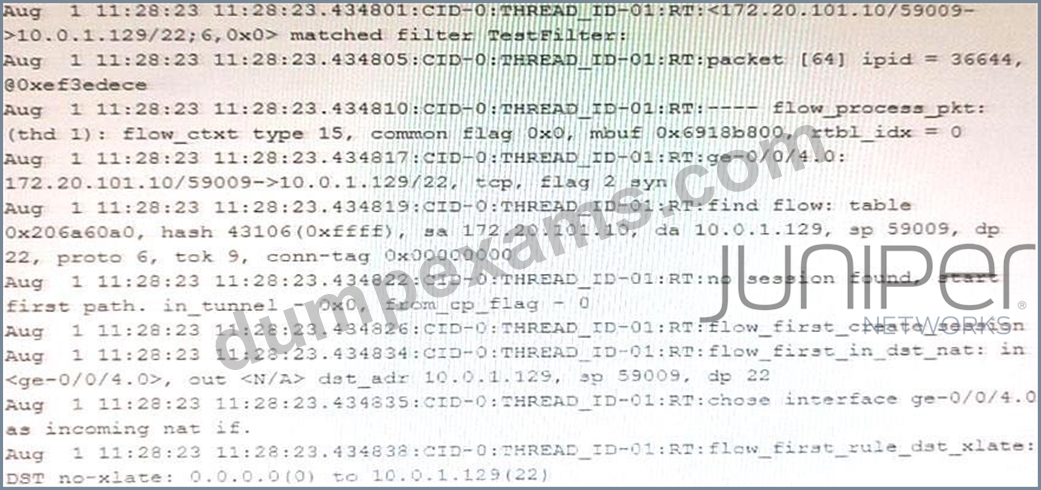
The exhibit shows a snippet of a security flow trace.
In this scenario, which two statements are correct? (Choose two.)
- A. The capture is a packet from the source address 172.20.101.10 destined to 10.0.1.129.
- B. An existing session is found in the table.
- C. This packet arrived on interface ge-0/0/4.0.
- D. Destination NAT occurs.
Answer: A,B
NEW QUESTION # 70
Referring to the exhibit,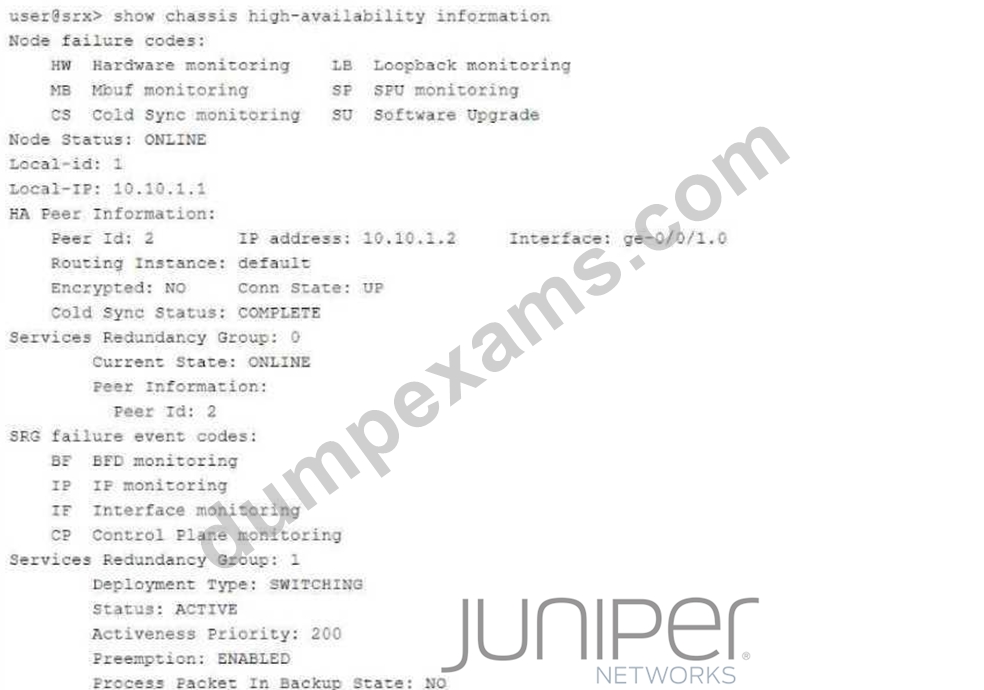
which three statements about the multinode HA environment are true? (Choose three.)
- A. IP monitoring has failed for the services redundancy group.
- B. Node 2 will process transit traffic that it receives for services redundancy group 1.
- C. Node 1 will host services redundancy group 1 unless it is unavailable.
- D. Session state is synchronized on both nodes.
- E. Two services redundancy groups are available.
Answer: C,D,E
NEW QUESTION # 71
Your IPsec tunnel is configured with multiple security associations (SAs). Your SRX Series device supports the CoS-based IPsec VPNs with multiple IPsec SAs feature. You are asked to configure CoS for this tunnel.
Which two statements are true in this scenario? (Choose two.)
- A. The local and remote gateways do not need the forwarding classes to be defined in the same order.
- B. The local and remote gateways must have the forwarding classes defined in the same order.
- C. A maximum of four forwarding classes can be configured for a VPN with the multi-sa forwarding- classes statement.
- D. A maximum of eight forwarding classes can be configured for a VPN with the multi-sa forwarding- classes statement.
Answer: B,D
Explanation:
When configuring CoS for an IPsec tunnel with multiple security associations (SAs):
* Forwarding Classes Order (Answer C): Both the local and remote SRX devices must have the same forwarding classes defined in the same order to ensure proper traffic classification and SA mapping. If not aligned, traffic classification can fail.
Command Example:
bash
Copy code
set security ipsec vpn vpn_name multi-sa forwarding-classes [class1 class2 ...]
* Maximum Forwarding Classes (Answer D): The multi-sa forwarding-classes statement allows up to eightforwarding classes. This is the maximum number of traffic classes that can be differentiated within a single VPN tunnel.
Command Example:
bash
Copy code
set security ipsec vpn vpn_name multi-sa forwarding-classes [class1 class2 class3 class4 class5 class6 class7 class8]
NEW QUESTION # 72
Exhibit: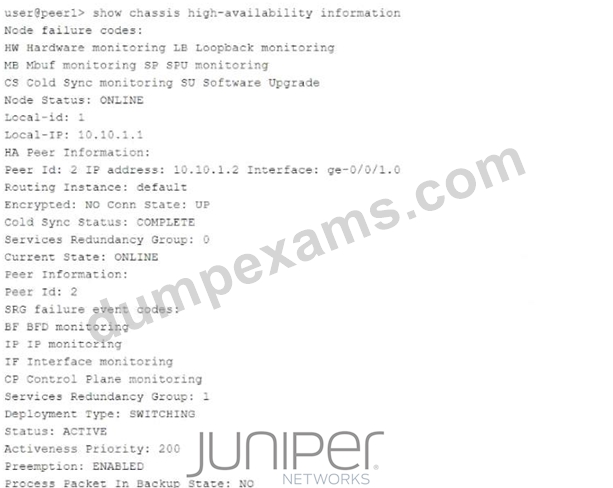
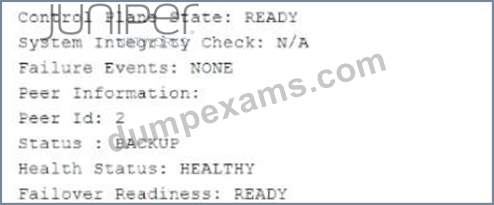
Referring to the exhibit, which statement is true?
- A. SRG1 is configured in hybrid mode.
- B. The ICL is encrypted.
- C. If SRG1 moves to peer 2, peer 1 will drop packets sent to the SRG1 interfaces.
- D. If SRG1 moves to peer 2, peer 1 will forward packets sent to the SRG1 interfaces.
Answer: D
Explanation:
The exhibit describes a Chassis Cluster configuration with high availability (HA) settings. The key information is related to Service Redundancy Group 1 (SRG1) and its failover behavior between the two peers.
* Explanation of Answer D (Packet Forwarding after Failover):
* In a typical SRX HA setup with active/backup configuration, if the SRG1 group moves to peer
2 (the backup), peer 1 (previously the active node) will forward packets to peer 2 instead of dropping them. This ensures smooth failover and seamless continuation of services without packet loss.
* This behavior is part of the active/backup failover process in SRX chassis clusters, where the standby peer takes over traffic processing without disruption.
Juniper Security Reference:
* Chassis Cluster Failover Behavior: When a service redundancy group fails over to the backup peer, the previously active peer forwards traffic to the new active node. Reference: Juniper Chassis Cluster Documentation.
NEW QUESTION # 73
You are deploying IPsec VPNs to securely connect several enterprise sites with ospf for dynamic routing. Some of these sites are secured by third-party devices not running Junos.
Which two statements are true for this deployment? (Choose two.)
- A. OSPF over IPsec can be used for intersite dynamic routing.
- B. Sites with overlapping address spaces cannot be supported.
- C. Sites with overlapping address spaces can be supported.
- D. OSPF over GRE over IPsec is required to enable intersite dynamic routing
Answer: C,D
NEW QUESTION # 74
You want to bypass IDP for traffic destined to social media sites using APBR, but it is not working and IDP is dropping the session.
What are two reasons for this problem? (Choose two.)
- A. The session did not properly reclassify midstream to the correct APBR rule.
- B. The APBR rule does a match on the first packet.
- C. IDP disable is not configured on the APBR rule.
- D. The application services bypass is not configured on the APBR rule.
Answer: A,D
Explanation:
APBR (Advanced Policy-Based Routing) requires the session to be classified based on the specified rule, which can change midstream as additional packets are processed. If the session was already established before the APBR rule took effect, the traffic may not be correctly reclassified to match the new APBR rule, leading to IDP (Intrusion Detection and Prevention) processing instead of being bypassed. This can occur especially when the session was already established before the rule change.
For APBR to work and bypass the IDP service, the application services bypass must be explicitly configured. Without this configuration, the APBR rule may redirect the traffic, but the IDP service will still inspect and potentially drop the traffic. This is especially important for traffic destined for specific sites like social media platforms where bypassing IDP is desired.
NEW QUESTION # 75
Referring to the exhibit,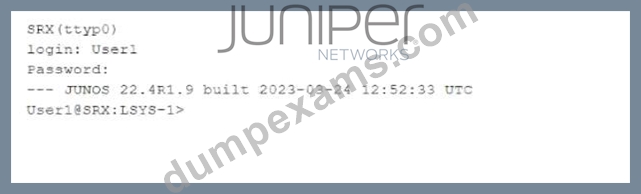
which two statements about User1 are true? (Choose two.)
- A. User1 can add logical units to an interface that a primary administrator has not previously assigned.
- B. User1 can view outputs from other user logical systems.
- C. User1 has access to the configuration specific to their assigned logical system.
- D. User1 is logged in to logical system LSYS-1.
Answer: C,D
Explanation:
In this configuration, User1 is logged into logical system LSYS-1, which restricts access and visibility to that particular system. This ensures isolation between logical systems on the same physical device. Only a system administrator can assign additional permissions. For more details, see Juniper Logical Systems Guide.
From the exhibit, we see that User1 is logged into logical system LSYS-1:
* Access to Assigned Logical System (Answer A): User1, being logged into the logical system LSYS-1, only has access to the configuration and interfaces within that logical system. This is a key feature of logical systems in Junos, ensuring users are restricted to their respective environments.
* Logged into LSYS-1 (Answer B): The prompt shows that User1 is currently operating in LSYS-1, as indicated by the User1@SRX:LSYS-1> command line.
NEW QUESTION # 76
Exhibit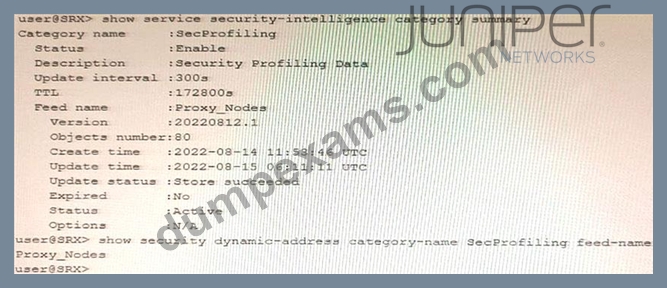
You have recently configured Adaptive Threat Profiling and notice 20 IP address entries in the monitoring section of the Juniper ATP Cloud portal that do not match the number of entries locally on the SRX Series device, as shown in the exhibit.
What is the correct action to solve this problem on the SRX device?
- A. You must configure the DAE in a security policy on the SRX device.
- B. Flush the DNS cache on the SRX device.
- C. Force a manual download of the Proxy__Nodes feed.
- D. Refresh the feed in ATP Cloud.
Answer: B
NEW QUESTION # 77
You want to create a connection for communication between tenant systems without using physical revenue ports on the SRX Series device.
What are two ways to accomplish this task? (Choose two.)
- A. Use a secure wire.
- B. Use an external router.
- C. Use a point-to-point logical tunnel.
- D. Use an interconnect VPLS switch.
Answer: C,D
Explanation:
Explanation:
NEW QUESTION # 78
Referring to the exhibit,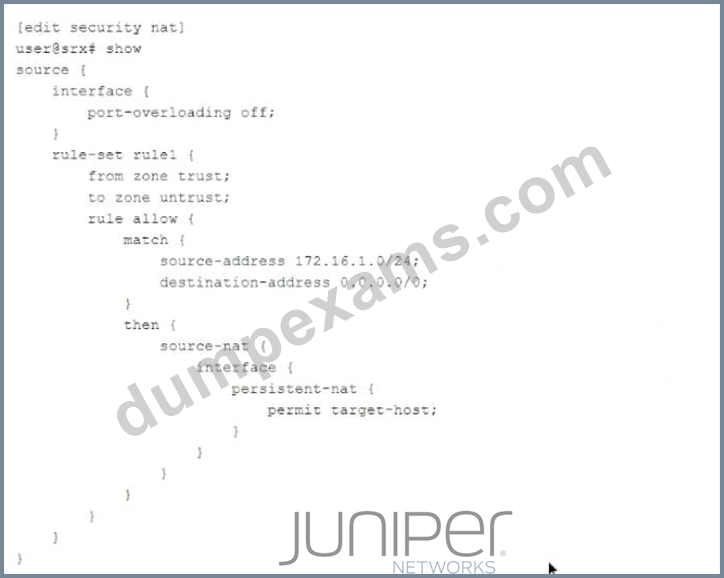
which two statements are correct about the NAT configuration? (Choose two.)
- A. Both the internal and the external host can initiate a session after the initial translation.
- B. Any external host will be able to initiate a session to the reflexive address.
- C. Only a specific host can initiate a session to the reflexive address after the initial session.
- D. The original destination port is used for the source port for the session.
Answer: A,C
Explanation:
Explanation:
NEW QUESTION # 79
Exhibit: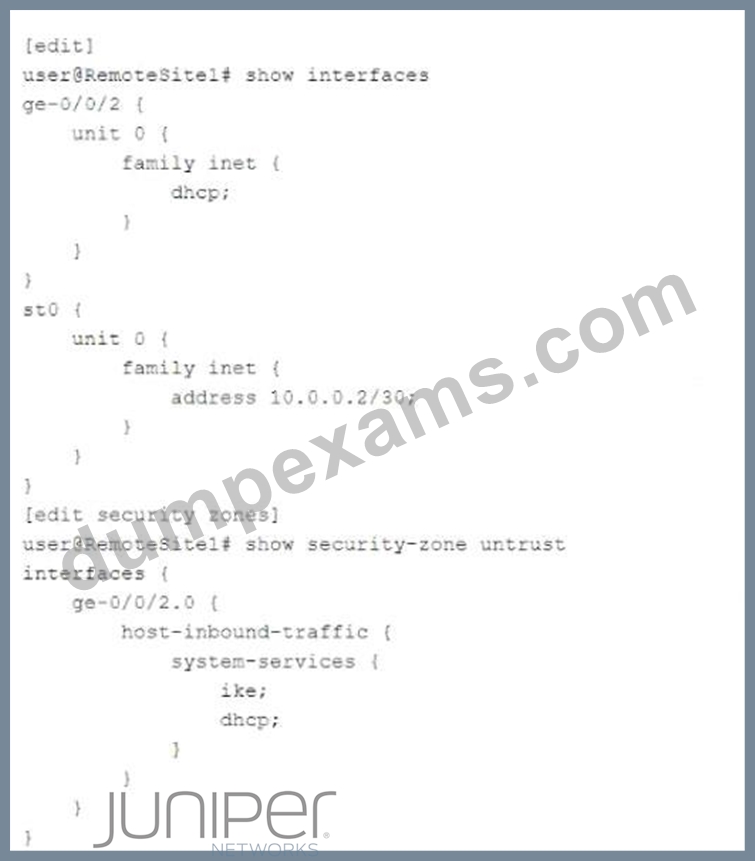
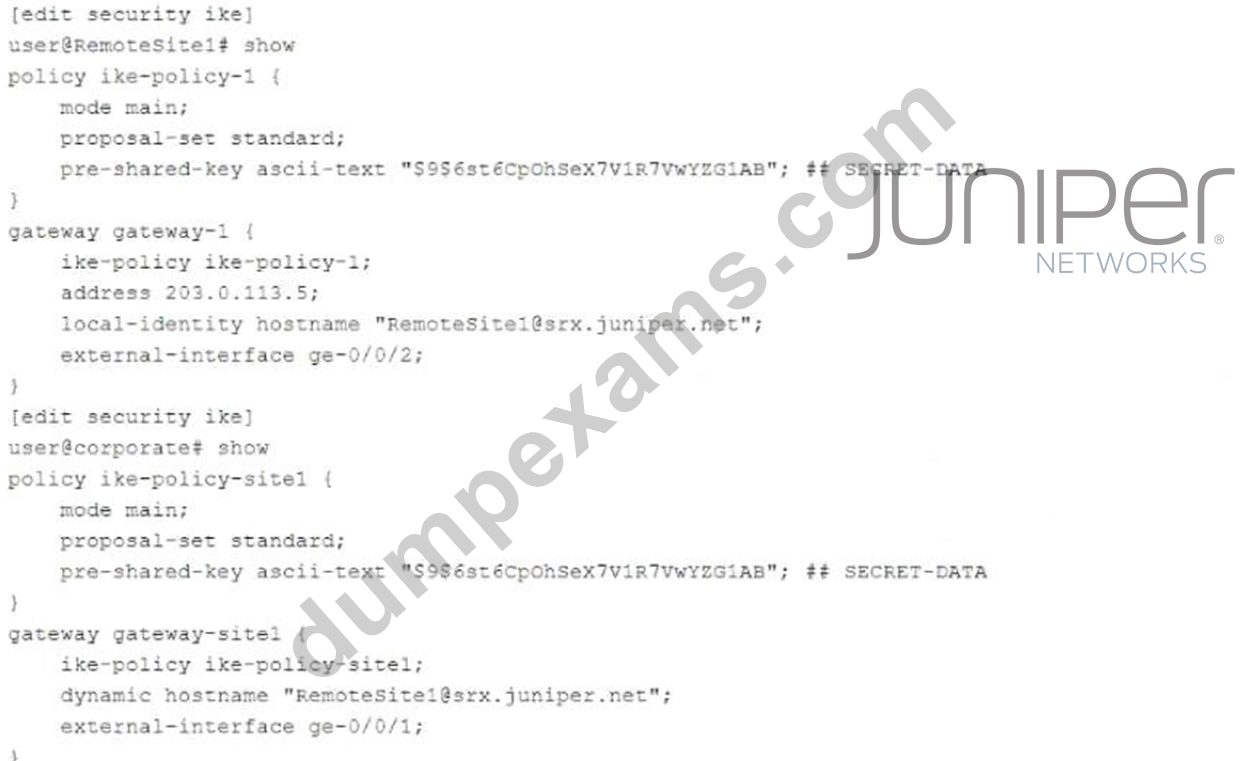
You are troubleshooting a new IPsec VPN that is configured between your corporate office and the RemoteSite1 SRX Series device. The VPN is not currently establishing. The RemoteSite1 device is being assigned an IP address on its gateway interface using DHCP.
Which action will solve this problem?
- A. On both devices, change the IKE version to use version 2 only.
- B. On the RemoteSite1 device, change the IKE gateway external interface to st0.0.
- C. On both devices, change the IKE policy proposal set to basic.
- D. On both devices, change the IKE policy mode to aggressive.
Answer: D
Explanation:
Aggressive mode is required when an IP address is dynamically assigned, such as through DHCP, as it allows for faster establishment with less identity verification. More details are available in Juniper IKE and IPsec Configuration Guide.
The configuration shown in the exhibit highlights that the RemoteSite1 SRX Series device is using DHCP to obtain an IP address for its external interface (ge-0/0/2). This introduces a challenge in IPsec VPN configurations when the public IP address of the remote site is not static, as is the case here.
Aggressive mode in IKE (Internet Key Exchange) is designed for situations where one or both peers have dynamically assigned IP addresses. In this scenario, aggressive mode allows the devices to exchange identifying information, such as hostnames, rather than relying on static IP addresses, which is necessary when the remote peer (RemoteSite1) has a dynamic IP from DHCP.
* Correct Action (D): Changing the IKE policy mode to aggressive will resolve the issue by allowing the two devices to establish the VPN even though one of them is using DHCP. In aggressive mode, the initiator can present its identity (hostname) during the initial handshake, enabling the VPN to be established successfully.
* Incorrect Options:
* Option A: Changing the external interface to st0.0 is incorrect because the st0 interface is used for the tunnel interface, not for the IKE negotiation.
* Option B: Changing to IKE version 2 would not resolve the dynamic IP issue directly, and IKEv1 works in this scenario.
* Option C: Changing the IKE proposal set to basic doesn't address the dynamic IP challenge in this scenario.
Juniper References:
* Juniper IKE and VPN Documentation: Provides details on when to use aggressive mode, especially when a dynamic IP address is involved.
NEW QUESTION # 80
You are using ADVPN to deploy a hub-and-spoke VPN to connect your enterprise sites.
Which two statements are true in this scenario? (Choose two.)
- A. IBGP routing is required.
- B. OSPF routing is required.
- C. Certificate-based authentication is required.
- D. ADVPN creates a full-mesh topology.
Answer: B,C
Explanation:
Explanation:
NEW QUESTION # 81
Refer to the exhibit,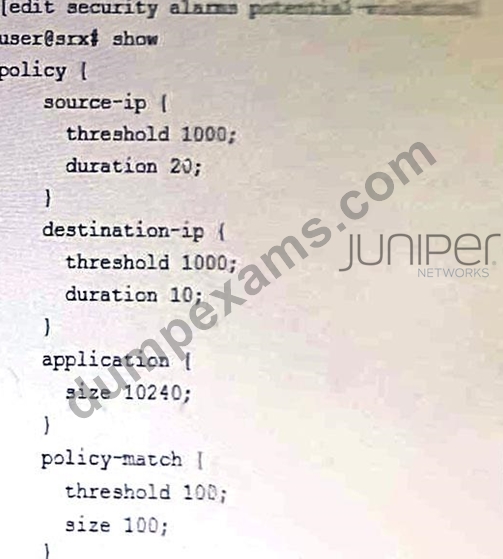
which two potential violations will generate alarm ? (Choose Two)
- A. the ratio of policy violation traffic compared to accepted traffic.
- B. the number of policy violations by a source network identifier
- C. the number of policy violation by a destination TCP port
- D. the number of policy violation to an application within a specified period
Answer: B,D
Explanation:
The exhibit shows a security policy configuration with a threshold of 1000 policy violations by a source network identifier and a threshold of 10 policy violations to an application within a specified period. If either of these thresholds are exceeded, an alarm will be generated. Therefore, the correct answer is A and D. The other options are incorrect because:
B) The ratio of policy violation traffic compared to accepted traffic is not a criterion for triggering an alarm.
The security policy configuration does not specify any ratio or percentage of policy violation traffic that would cause an alarm.
C) The number of policy violation by a destination TCP port is also not a criterion for triggering an alarm.
The security policy configuration does not specify any threshold or duration for policy violation by a destination TCP port.
Reference: policy (Security Alarms)
Monitoring Security Policy Violations
NEW QUESTION # 82
You are configuring an interconnect logical system that is configured as a VPLS switch to allow two logical systems to communicate.
Which two parameters are required when configuring the logical tunnel interfaces? (Choose two.)
- A. The virtual tunnel interfaces should only be configured with two logical unit pairs per logical system interconnect.
- B. Encapsulation ethernet must be used.
- C. Encapsulation ethernet-vpls must be used.
- D. The logical tunnel interfaces should be configured with two logical unit pairs per logical system interconnect.
Answer: C,D
NEW QUESTION # 83
......
100% Free JN0-637 Daily Practice Exam With 125 Questions: https://www.dumpexams.com/JN0-637-real-answers.html
JN0-637 exam torrent Juniper study guide: https://drive.google.com/open?id=14Agz2vniiTWmMwG_oLDK5JMX4GXOv5HC