


[Nov 19, 2023] Dumpexams 1z0-1072-22 dumps & Oracle Cloud Solutions Infrastructure sure practice dumps
Oracle 1z0-1072-22 Actual Questions and Braindumps
NEW QUESTION # 29
You have an application server running in a public subnet on a compute instance in US West (us-phoenix-1) region of Oracle Cloud Infrastructure (OCI).The data sitting on this instance needs to be copied to OCI Object storage bucket available in the same region without traversing over the internet. To enable the connectivity between the instance and Object Storage, you created a service gateway with service CIDR of all Object Storage in us-phoenix-1 enabled. You also modified the security rules to allow the desired traffic.
However, when you tried sending the data to the Object Storage bucket, you notice that the data is going over the internet and not via the service gateway.
What could be the possible reason for this behavior?
- A. The service gateway created in the VCN resides in a differentavailability domain
- B. The security list associated with the subnet has an egress rule that allows all traffic to be forwarded to a destination CIDR 0.0.0.0/0
- C. Identity and Access Management (IAM) policies restrict the access to the object storage bucket
- D. The route table associated with the subnet has no route rule where the destination is object storage service
Answer: D
NEW QUESTION # 30
You are designing a shared storage solution for your company in Oracle Cloud Infrastructure. The proposed storage solution should allow users to create a hierarchical structure (similar to the directory structure in Linux or Windows based systems). The solution should provide data encryption and a large amount of storage space.
Which would be the best implementation strategy?
- A. Use object storage. Create multiple namespaces with one bucket each. Make the buckets publicly accessible.
- B. Use file storage service. Create a file system and a mount target. Share the private IP of the mount target.
- C. Use object storage. Create a single namespace and multiple buckets to create the hierarchical directory structure.
- D. Use block storage. Create and attach a large block storage volume to one compute instance. Assign a public IP to the compute instance. Store data on the block storage and access it by connecting to the compute instance.
Answer: B
NEW QUESTION # 31
Which two statements are true about Autonomous Data Warehouse (ADW) backup?
- A. You must backup ADW database to object storage bucket named ADW_backup
- B. You can backup ADW database onlyto a standard bucket type in OCI object storage
- C. You can perform manual backups to OCI object storage in addition to automated backups available on ADW
- D. Oracle Cloud Infrastructure (OCI) recommends backing up ADW databases manually to on-premises storage devices
Answer: B,C
Explanation:
Explanation
Autonomous Database automatically backs up your database for you.In addition to automatic backups Autonomous Database also allows you take manual backups to your Oracle Cloud Infrastructure Object Storage. for example if you want to take a backup before amajor change to make restore and recovery faster.
Also, Manual backups are only supported with buckets created in the standard storage tier if you provision an Autonomous Data Warehouse instance named ADWC1, the bucket name should be backup_adwc1 (the bucket name is lowercase)
NEW QUESTION # 32
What is the maximum number of security lists that can be associated with a subnet?
- A. two
- B. four
- C. five
- D. three
Answer: C
Explanation:
Explanation
you may optionally specify one or more security lists for the subnet to use (up to five). If you don't specify any, the subnet uses the cloud network's default security list. You canchange which security list the subnet uses at any time.
https://docs.cloud.oracle.com/iaas/Content/Network/Tasks/managingVCNs.htm
NEW QUESTION # 33
You have compartments C and D under the root compartment in your Oracle Cloud Infrastructure (OCI) tenancy; compartment C contains a sub-compartment also named D. You are trying to move this sub-compartment D to the parent compartment D like shown in the picture, but the move fails.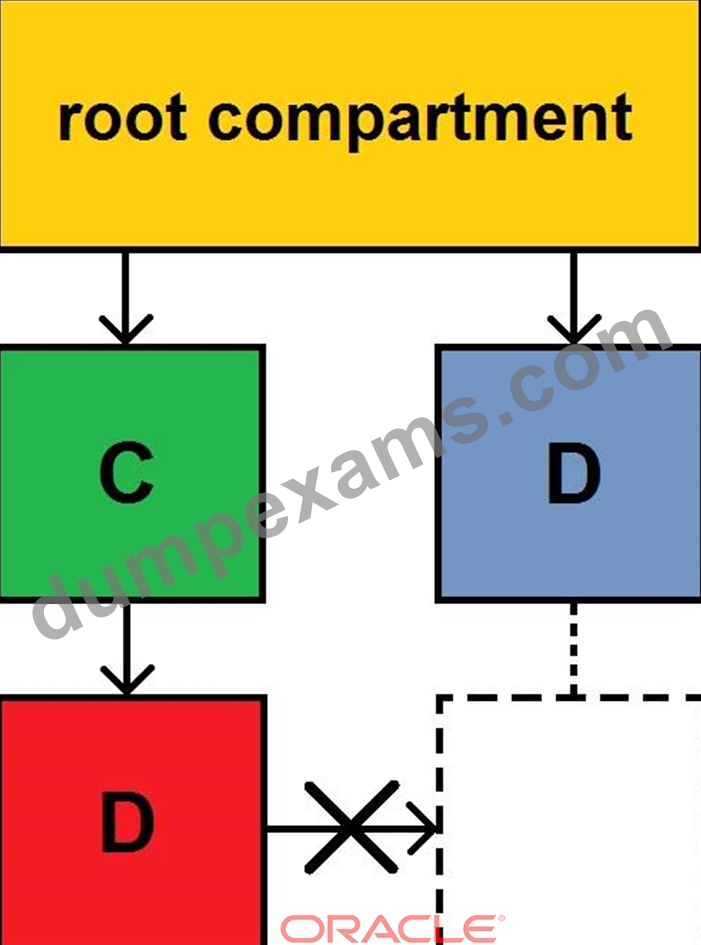
What is the reason for this error?
- A. You cannot move a subcompartment to another parent compartment.
- B. Both parent and child compartments cannot have the same name.
- C. You need to move all the compartments in the hierarchy to the new parent compartment.
- D. Sub-compartment D needs to be empty before it can be moved.
Answer: B
Explanation:
Reference:
(restriction on moving compartments)
NEW QUESTION # 34
You have provisioned an Autonomous Transaction Processing (ATP) database and logged into the ATP service console.
What are three abilities that can be performed from this service console? (Choose three.)
- A. create ATP database users
- B. set resource management rules
- C. monitor database activity and SQL queries
- D. reset the admin password
- E. scale up/down the CPUs
Answer: B,C,D
Explanation:
Explanation
In ATP Service Console,
In the activity screen allows you to perform some basic monitor database activity and SQL queries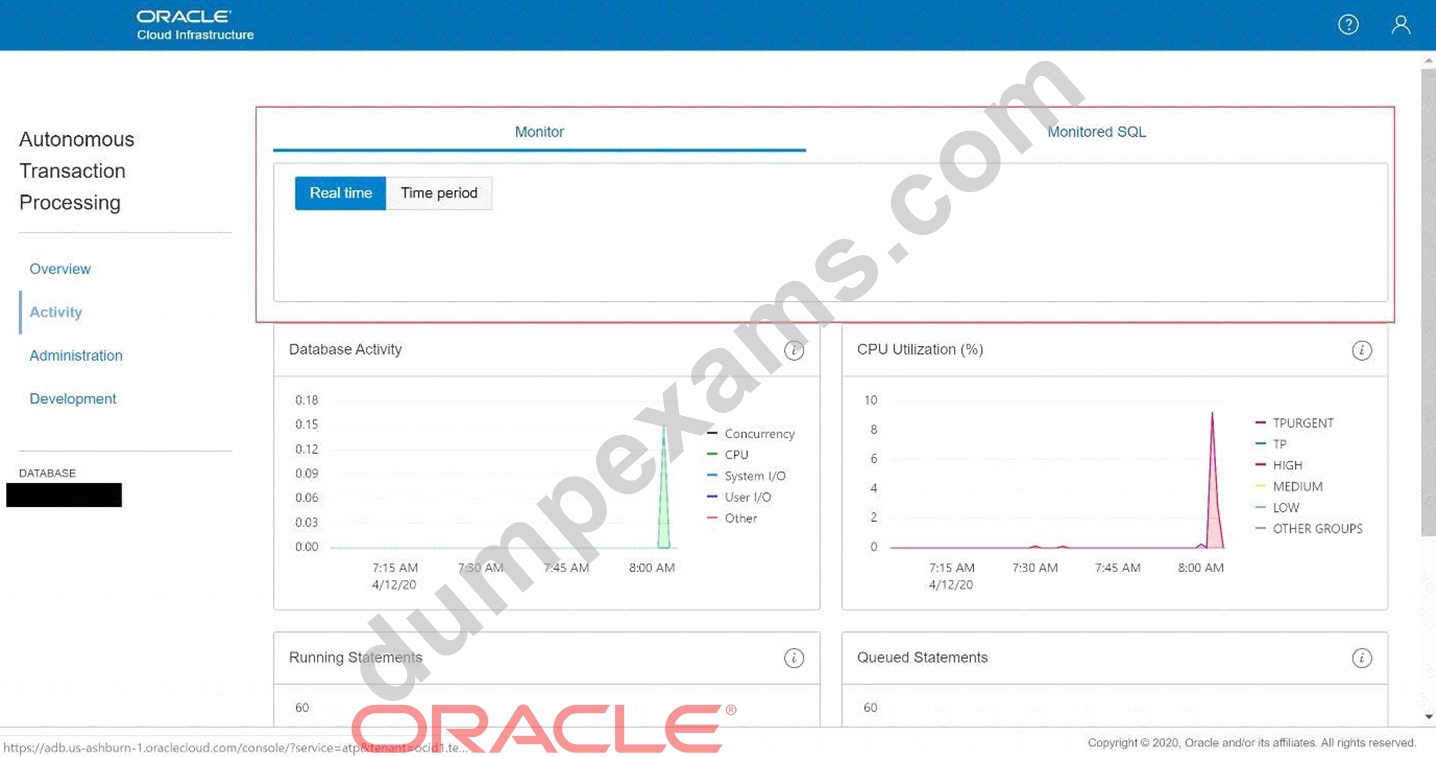
In the administration screen allows you toperform some basic administration of the service, like reset the admin password and set resource management rules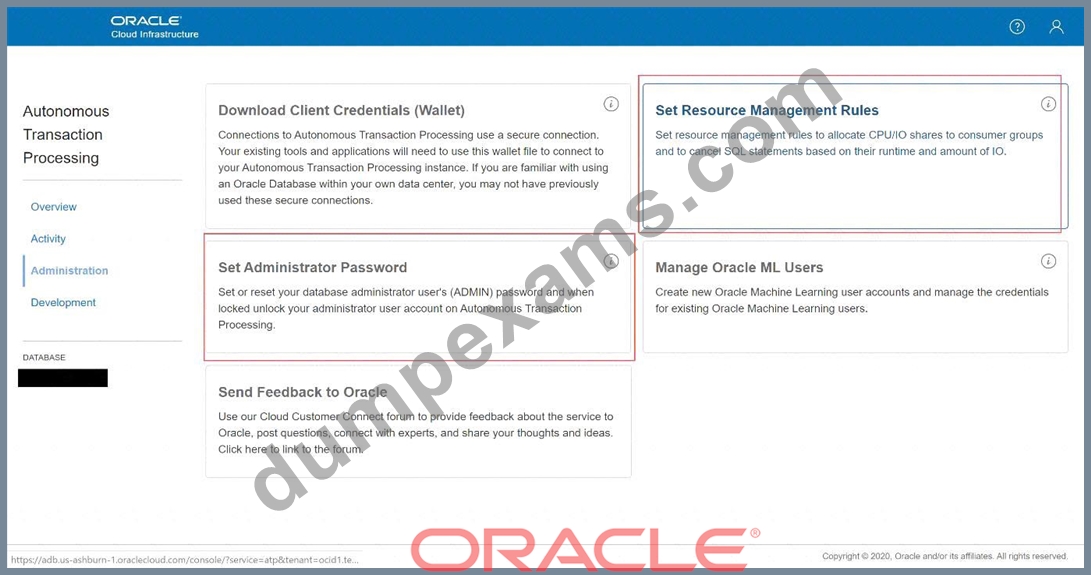
NEW QUESTION # 35
Which two are true for achieving High Availability on Oracle Cloud Infrastructure? (Choose two.)
- A. Distribute your application servers across all Availability Domains within a region.
- B. Configure your database to have Data Guard in another Availability Domain in Sync mode within a region.
- C. Attach your block volume form Availability Domain 1 to a compute instance in Availability Domain 2 (and vice versa) so that they are highlyavailable.
- D. Store your database files on Object Storage so that they are available in all Availability Domains in all regions.
- E. Store your database across multiple regions so that half of the data resides in one region and the other half resides in another region.
Answer: A,B
NEW QUESTION # 36
Which statement is true about Data Guard Implementation in DB systems?
- A. You cannot manage the database as sys/sysdba.
- B. Both DB systems must be in the same compartment, and they must be the same shape
- C. You cannot manage Oracle database initialization parameters at a global level.
- D. You can define the backup window and set custom backup retention period for the automatic database backup schedule.
Answer: B
Explanation:
An Oracle Data Guard implementation requires two DB systems, one containing the primary database and one containing the standby database. When you enable Oracle Data Guard for a virtual machine DB system database, a new DB system with the standby database is created and associated with the primary database. For a bare metal DB system, the DB system with the database that you want to use as the standby must already exist before you enable Oracle Data Guard.
Requirement details are as follows:
- Both DB systems must be in the same compartment.
- The DB systems must be the same shape type (for example, if the shape of the primary database is a virtual machine, then the shape of the standby database can be any other virtual machine shape).
- If your primary and standby databases are in different regions, then you must peer the virtual cloud networks (VCNs) for each database. See Remote VCN Peering (Across Regions).
- Configure the security list ingress and egress rules for the subnets of both DB systems in the Oracle Data Guard association to enable TCP traffic to move between the applicable ports. Ensure that the rules you create are stateful (the default).
NEW QUESTION # 37
Your company is moving an Internet-facing, 2-tier web application into Oracle Cloud Infrastructure. The application must have a highly availablearchitecture.
Which two design options would you consider? (Choose two.)
- A. Configure a NAT instance in your Virtual Cloud Network (VCN). Create a route rule by using the private IP of the NAT instance as a route target for all the private subnets in your VCN.
- B. Place all web servers behind a public load balancer.
- C. Create an Internet Gateway and attach it to your VCN. Deploy public load balancer nodes into two Available Domains.
- D. Configure a Dynamic Route Gateway in your VCN and make it highly available.
Answer: B,C
NEW QUESTION # 38
Which two are Regional resources in Oracle Cloud Infrastructure? (Choose two.)
- A. Dynamic groups
- B. Ephemeral public IPs
- C. Block volume backups
- D. Compute images
- E. Compartments
Answer: A,E
NEW QUESTION # 39
Which certificate format is used with the load balancer?
- A. PKCS12
- B. PFX
- C. PEM
- D. CRT
Answer: C
Explanation:
https://docs.cloud.oracle.com/iaas/Content/Balance/Tasks/managingcertificates.htm
NEW QUESTION # 40
Whichtwo choices are true for Autonomous Data Warehouse (ADW)? (Choose two.)
- A. Billingfor storage continues when ADW is stopped
- B. Billing stops only when the ADW is terminated
- C. Billing stops for both CPU usage and storage usage when ADW is stopped
- D. Billing for compute stops when ADW is stopped
Answer: A,D
Explanation:
Explanation
When Autonomous Databas instance is stopped,
CPU billing is halted based on full-hour cycles of usage
Billing for storage continues as long as the service instance exists.
and When AutonomousDatabase instance is started, the CPU billing is initiated
NEW QUESTION # 41
You have two line of business operations (LOB1, LOB2) leveraging Oracle Cloud Infrastructure. LOB1 is deployed in VCN1 in the OCI US East region, while LOB2 is deployed in VCN2 in the US West region. You need to peer VCN1 and VCN2 for disaster recovery and data backup purposes. To ensure you can utilize the OCI Virtual Cloud Network remote peering feature, which CIDR ranges should be used?
- A. VCN1 (172.16.1.0/24) and VCN2 (172.16.1.0/27)
- B. VCN1 (10.0.0.0/16) and VCN2 (10.0.1.0/24)
- C. VCN1 (192.168.0.0/16) and VCN2 (192.168.1.0/27)
- D. VCN1 (10.0.0.0/16) and VCN2 (172.16.0.0/16)
Answer: D
Explanation:
Explanation
VCN1 (10.0.0.0/16) will use the IP Range from 10.0.0.0 to 10.0.255.255 and the VNC 2 (172.16.0.0/16) will use the IP Range from 172.16.0.0 to 172.16.255.255 the will not be overlap between the 2 VCN
NEW QUESTION # 42
Within your tenancy you have a compute instance with a boot volume and a block volume attached. The boot volume contains the OS and the attached block volume contains the instance's important data. Logs on the boot volume have filled the boot volume and are causing issues with the OS.
What should you do to resolve this situation?
- A. Stop the instance that is full. Create a manual backup of the block storage before making changes.
Detach the block volume, create a new instance ofthe same shape with a larger custom boot volume and attach the block volume to the new instance. Configure the OS and any related application(s) to access the block volume under the same mount point as before. - B. Detach the block volume from the full instance. Create a new instance of the same shape with a larger boot volume and rsync the state of the boot volume between the instances. Attach the block volume to the new instance.
- C. Create a manual backup of the block storage instance. Create a custom imageof the full instance. Once that completes deploy the custom image to a new instance.
- D. Create a new instance with a larger boot volume size as well a new block volume which is the same size or larger than the one attached to the full instance. rsync the state of the boot volume and the state of the block volume between the two instances.
Answer: A
Explanation:
Explanation
https://docs.cloud.oracle.com/en-us/iaas/Content/Block/Tasks/resizingavolume.htm
NEW QUESTION # 43
Which two statements about the Oracle File Storage Service (FSS) Security are accurate? (Choose two.)
- A. Oracle IAM controls which filesystems are mountable by which instances.
- B. FSS leverages UNIX user group and permission checkingfor file access security.
- C. Security lists can be used asa virtual firewall to prevent an instance from mounting an FSS mount target within a subnet.
- D. Encryption of file storage in FSS is optional.
- E. Data in transit to an FSS mount target is encrypted.
Answer: B,E
Explanation:
Explanation
All data is encrypted at rest. and In-transit encryption provides a way to secure your data between instances and mounted file systems using TLS v. 1.2 (Transport Layer Security) encryption.
File Storage service supports the AUTH_UNIX style of authentication and permission checking for remote NFS client requests.
NEW QUESTION # 44
Which two choices are true for Oracle Autonomous Database with Shared Exadata Infrastructure?
- A. Billing stops for both CPU and storage usage when autonomous database is stopped.
- B. Billing for storage usage continues when autonomous database is stopped.
- C. Billing for compute usage stops when autonomous database is stopped.
- D. Billing does not stop when autonomous database is terminated.
- E. Autonomous database does not support per-second billing.
Answer: B,C
NEW QUESTION # 45
Your company decided to move a few applications to Oracle Cloud Infrastructure (OCI)in the US West (us-phoenix-1) region.
You need to design a cloud-based disaster recovery (DR) solution with a requirement to deploy the DR resources in the US East (us-ashburn-1) region to minimize network latency.
What is the recommended deployment?
- A. Deploy production and DR applications in the same VCN. Create production subnets in one AD, and DR subnets in another AD (assume a multi-AD region).
- B. Deploy production and DR applications in two separate VCNs, each in different regions. Connect them using a VCN remote peering connection.
- C. Deploy production and DR applications in twoseparate VCNs in different availability domains (ADs) within the primary region, and then use a VCN remote peering connection for connectivity.
- D. Deploy production and DR applications in two separate virtual cloud networks (VCNs), each in different regions, and then use VCN local peering gateways for connectivity.
Answer: D
Explanation:
Explanation
Remote VCN peering is the process of connecting two VCNs in different regions The peering allows theVCNs' resources to communicate using private IP addresses without routing the traffic over the internet or through your on-premises network.
NEW QUESTION # 46
Which two Oracle Cloud Infrastructure database services allow you to dynamically both scale CPU and storage? (Choose two.)
- A. bare metal DB system
- B. Autonomous Transaction Processing (ATP)
- C. virtual machine DB system
- D. Autonomous Data Warehouse (ADW)
Answer: B,D
Explanation:
If a bare metal DB system requires more compute node processing power, you can scale up (increase) the number of enabled CPU cores in the system without impacting the availability of that system but you can't increase the storage If the original DB system VM shape uses a single node, running databases on the DB system nodes are sequentially stopped and then restarted on the new shape so not dynamic
NEW QUESTION # 47
Which three must be configured for a load balancer to accept incoming traffic? (Choose two.)
- A. a listener
- B. a certificate
- C. a back-end server
- D. a security list that is open on a listener port
- E. a back end set
Answer: A,C,E
Explanation:
https://docs.cloud.oracle.com/iaas/Content/Balance/Tasks/managingloadbalancer.htm?tocpath=Services%7CLoad%20Balancing%7C_____5 The essential components for load balancing include: * A load balancer with pre-provisioned bandwidth. * A backend set with a health check policy. See Managing Backend Sets. * Backend servers for your backend set. See Managing Backend Servers. * One or more listeners . See Managing Load Balancer Listeners. * Load balancer subnet security rules to allow the intended traffic. To learn more about these rules, see Security Rules. * Optionally, you can associate your listeners with SSL server certificate bundles to manage how your system handles SSL traffic. See Managing SSL Certificates.
NEW QUESTION # 48
You need to set up instance principals so that an application running on an instance can call Oracle Cloud Infrastructure (OCI) public services, without the need to configure user credentials.
A developer in your team has already configured the application built using an OCI SDK to authenticate using the instance principals provider.
Which is NOT a necessary step to complete this set up?
- A. Create a dynamic group with matching rules to specify which instances you want to allow to make API calls against services.
- B. Create a policy granting permissions to the dynamic group to access services in your compartment or tenancy.
- C. Generate Auth Tokens to enable instances in the dynamic group to authenticate with APIs.
- D. Deploy the application and the SDK to all the instances that belong to the dynamic group.
Answer: D
NEW QUESTION # 49
Which two are true for Oracle Cloud Infrastructure DNS? (Choose two.)
- A. It supports other cloud providers such as AWS and Azure.
- B. It does not provide DDoS protection.
- C. It can function only as a primary DNS.
- D. It supports segregation of traffic by using the private pool.
Answer: A,D
Explanation:
Reference: B - Support for Oracle Cloud Infrastructure, other Cloud provider endpoints (AWS, Azure) and private assets, including Cloud, CDNs and Data Centers C - Customers may purchase Oracle Cloud Infrastructure Private Pool and Vanity Nameserver to have their Domain Names and Zones under a private IP pool with dedicated nameservers to segregate from those of other customers in order to reduce the risk of external issues affecting their websites.
https://www.oracle.com/cloud/networking/dns-faq.html
NEW QUESTION # 50
......
Oracle 1z0-1072-22 certification exam is designed to test the knowledge of cloud architects who work with the Oracle Cloud Infrastructure (OCI) platform. Oracle Cloud Infrastructure 2022 Architect Associate certification exam validates the skills of candidates in deploying, managing, and securing cloud solutions using OCI. 1z0-1072-22 exam is intended for professionals who have experience in designing and implementing cloud architectures and who are familiar with the technologies and tools used in cloud computing.
Latest 1z0-1072-22 Pass Guaranteed Exam Dumps with Accurate & Updated Questions: https://www.dumpexams.com/1z0-1072-22-real-answers.html
Pass 1z0-1072-22 Exam with Updated 1z0-1072-22 Exam Dumps PDF 2023: https://drive.google.com/open?id=1q3r6A2v7af4Bb48BBqI1xIKhe_ce1ZoK